Round 15 · strip 4 of 4 · Monday, November 23, 2026

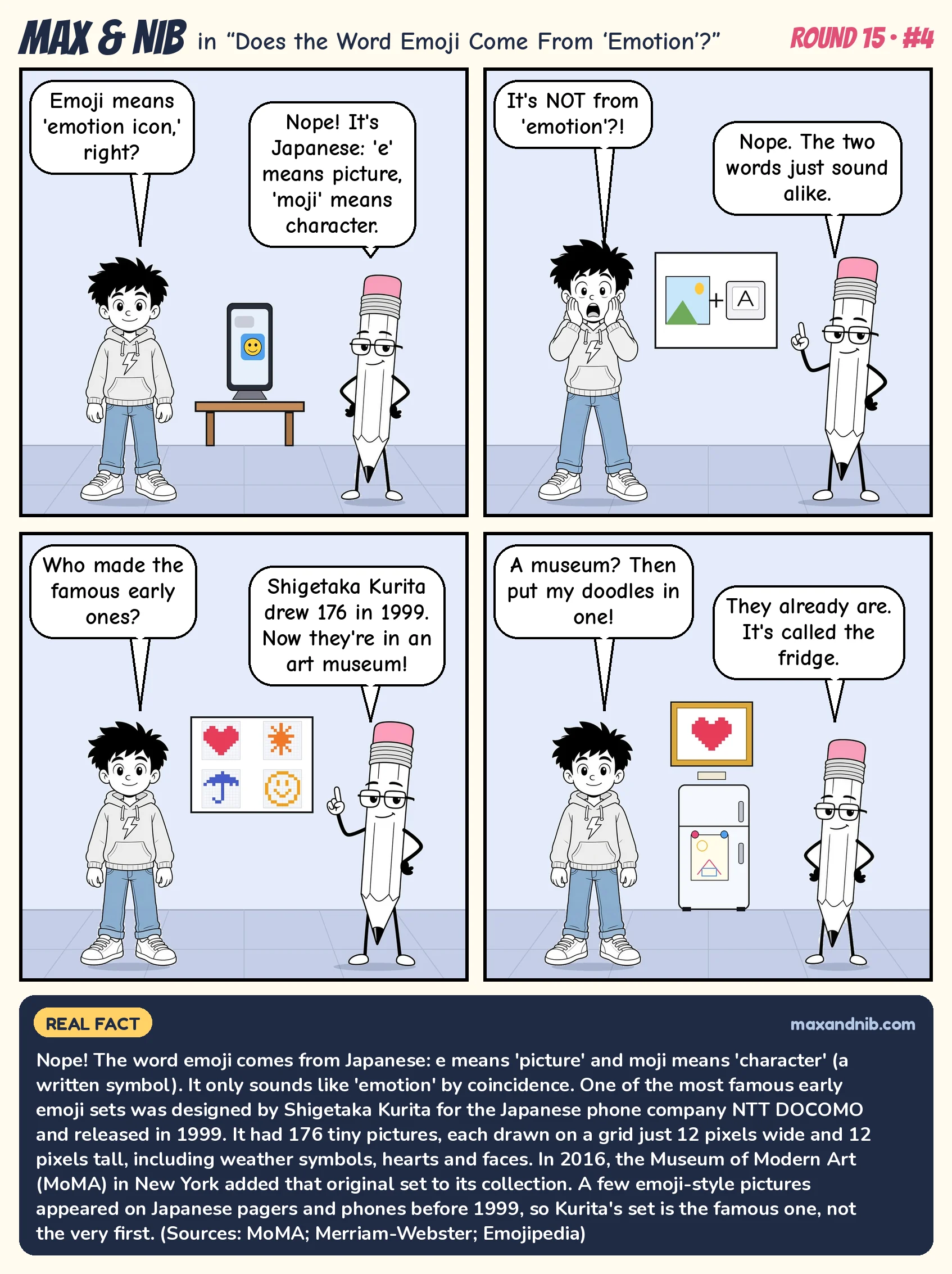
Max, next to a phone on a stand showing a chat with a smiley, says emoji means emotion icon; Nib says nope, it's Japanese: e means picture and moji means character. Max, shocked, says it's not from emotion; Nib points to a poster of a picture plus a letter key and says nope, the two words just sound alike. Max asks who made the famous early ones; Nib points to a poster of four pixel emoji on tiny grids (a heart, a sun, an umbrella and a smiley) and says Shigetaka Kurita drew 176 of them in 1999 and now they're in an art museum. Next to a gold museum frame holding a pixel heart, above a fridge with a crayon drawing, Max says then put his doodles in a museum too; Nib says they already are, it's called the fridge.
Comic · Tech

Does the Word Emoji Come From ‘Emotion’?

Real fact: Nope! The word emoji comes from Japanese: e means 'picture' and moji means 'character' (a written symbol). It only sounds like 'emotion' by coincidence. One of the most famous early emoji sets was designed by Shigetaka Kurita for the Japanese phone company NTT DOCOMO and released in 1999. It had 176 tiny pictures, each drawn on a grid just 12 pixels wide and 12 pixels tall, including weather symbols, hearts and faces. In 2016, the Museum of Modern Art (MoMA) in New York added that original set to its collection. A few emoji-style pictures appeared on Japanese pagers and phones before 1999, so Kurita's set is the famous one, not the very first. (Sources: MoMA; Merriam-Webster; Emojipedia)

Where this fact comes from