Round 15

The Biggest Moon, Green Sloths & Smelly Roman Laundry

Video · 29 sec · all words on screen, works muted

What's the Biggest Moon in the Solar System?

Real fact: Jupiter's moon Ganymede! NASA says Ganymede is the largest moon in our solar system. It is about 3,270 miles (5,260 kilometers) wide, while Earth's Moon is about 2,159 miles (3,475 kilometers) wide, so Ganymede is about 1.5 times as wide as our Moon. Ganymede is even wider than the planet Mercury (about 3,032 miles wide), but Mercury is still heavier: NASA's fact sheets list Mercury at more than twice Ganymede's mass, because Mercury is made of dense rock and metal while Ganymede is about half ice. Ganymede is also the only moon known to have its own magnetic field, and scientists think it hides a salty ocean under its icy crust. Widths are rounded.

Where this fact comes from
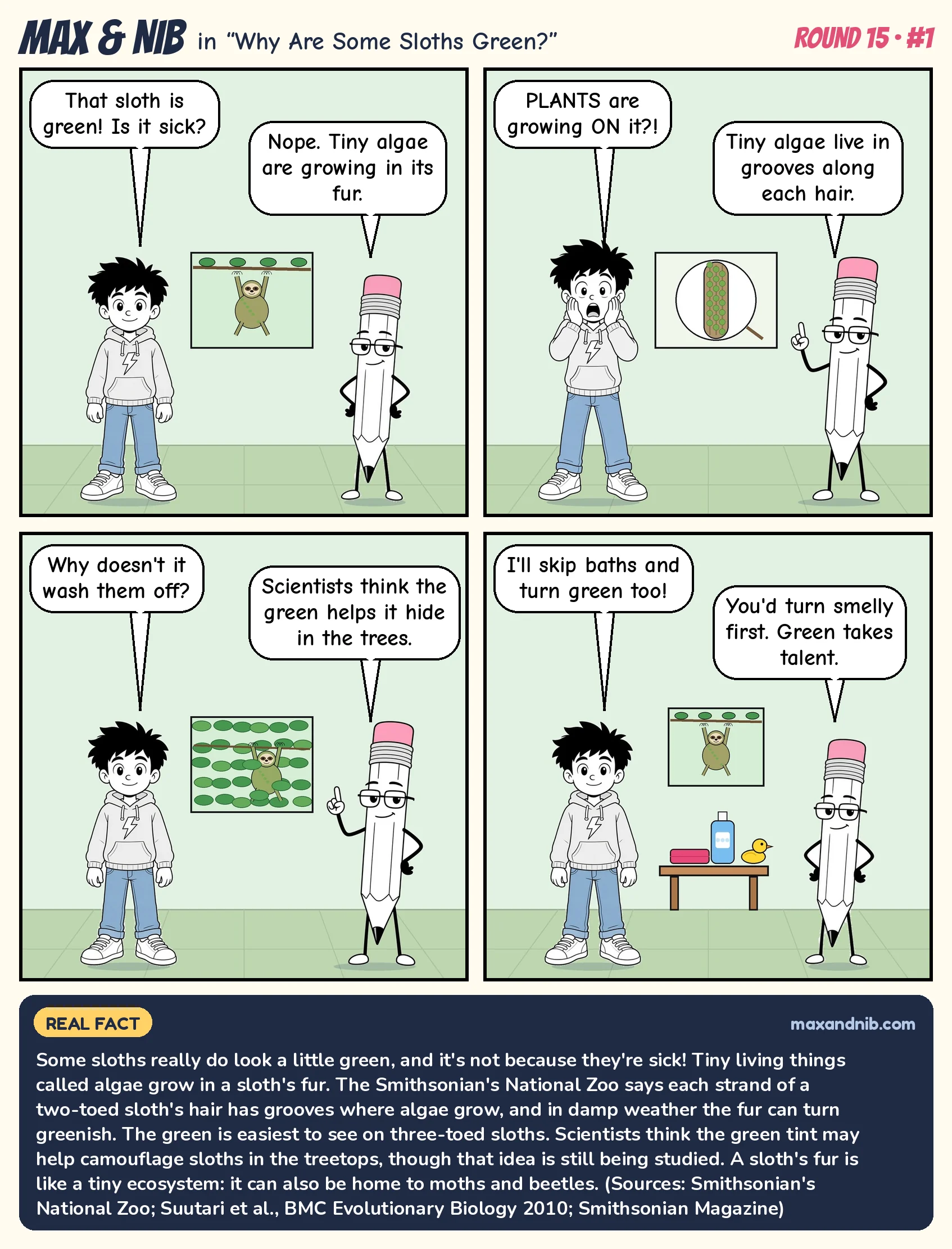
Max, next to a jungle poster of a greenish sloth hanging from a branch, asks if the sloth is sick because it's green; Nib says no, tiny algae grow in its fur. Max is shocked that plants grow on it; Nib points to a magnified sloth hair with grooves full of green algae and says tiny algae live in grooves along each hair. Max asks why the sloth doesn't wash it off; Nib points to a poster of a green sloth almost hidden among leaves and says scientists think the green helps it hide in the trees. Next to a table with a towel, shampoo and a rubber duck, Max says he'll skip baths and turn green too; Nib says he'd turn smelly first, because green takes talent.
Comic · Animals

Why Are Some Sloths Green?

Real fact: Some sloths really do look a little green, and it's not because they're sick! Tiny living things called algae grow in a sloth's fur. The Smithsonian's National Zoo says each strand of a two-toed sloth's hair has grooves where algae grow, and in damp weather the fur can turn greenish. The green is easiest to see on three-toed sloths. Scientists think the green tint may help camouflage sloths in the treetops, though that idea is still being studied. A sloth's fur is like a tiny ecosystem: it can also be home to moths and beetles. (Sources: Smithsonian's National Zoo; Suutari et al., BMC Evolutionary Biology 2010; Smithsonian Magazine)

Where this fact comes from
Max, shocked, next to a poster of a stomach with rumble lines, asks if there's a monster in his stomach; Nib says no monster, it's muscles squeezing gas and liquid along. Max asks if it only growls when he's hungry; Nib points to a poster of a gut tube being squeezed to push bubbles along and says nope, it can growl when he's full, too. Max, shocked, asks why it's so loud before lunch; Nib points to a poster of an empty stomach with big rumble lines next to a full stomach with small ones and says an empty belly has less food to muffle the noise. Under a wall clock, next to a table with a big sandwich, Max says quick, he needs a sandwich to muffle it; Nib says sure, purely for science.
Comic · Human Body

Why Does Your Stomach Growl?

Real fact: That rumble is called borborygmi (say it: bor-buh-RIG-me), and it's just your gut at work! The walls of your stomach and small intestine are made of muscle. They squeeze in waves to mix food and push gas and liquid along, and that makes noise. It can happen on an empty or a full stomach, and a lot of it comes from the small intestine, not just the stomach. It sounds loudest when you're hungry because there's less food in there to muffle the sound. About two hours after your stomach empties, extra 'housekeeping' squeezes sweep through to clear it out, and they can rumble too. A growl doesn't always mean you're hungry; feeling hungry is the better clue. (Sources: Scientific American; Harvard Health Publishing)

Where this fact comes from
Max, next to a poster of Roman temple columns with tunics drying on a line, asks how people did laundry before washing machines; Nib says some ancient Romans used old pee. Max, shocked, asks if they used pee on purpose; Nib points to a poster of a stone tub of yellowish liquid with cloth and bubbles and says aged pee makes ammonia, which helps lift grease and stains. Max asks how they scrubbed; Nib points to a poster of a Roman worker in a tunic stomping in the tub and says workers stomped the clothes with their feet. Next to a table with an overflowing laundry basket, Max says he's never complaining about laundry again; Nib says good, his socks are waiting, and no stomping needed.
Comic · History

Did Ancient Romans Wash Clothes With Pee?

Real fact: Yes, sometimes! Ancient Roman laundry and cloth workers, called fullers, used aged urine as one of their cleaners. Old urine turns into ammonia, which helps break down grease and lift stains. Workers put the cloth in tubs with water and cleaners, then stomped on it with their bare feet, a bit like a human washing machine. Historians note that a special clay called fuller's earth was probably used even more often, and the popular story that pee jars sat on every street corner for fullers is doubted by some experts. People in Europe kept using urine for tough stains for centuries after Roman times. (Sources: Smithsonian Magazine; Oxford Classical Dictionary, 'fulling'; World History Encyclopedia)

Where this fact comes from
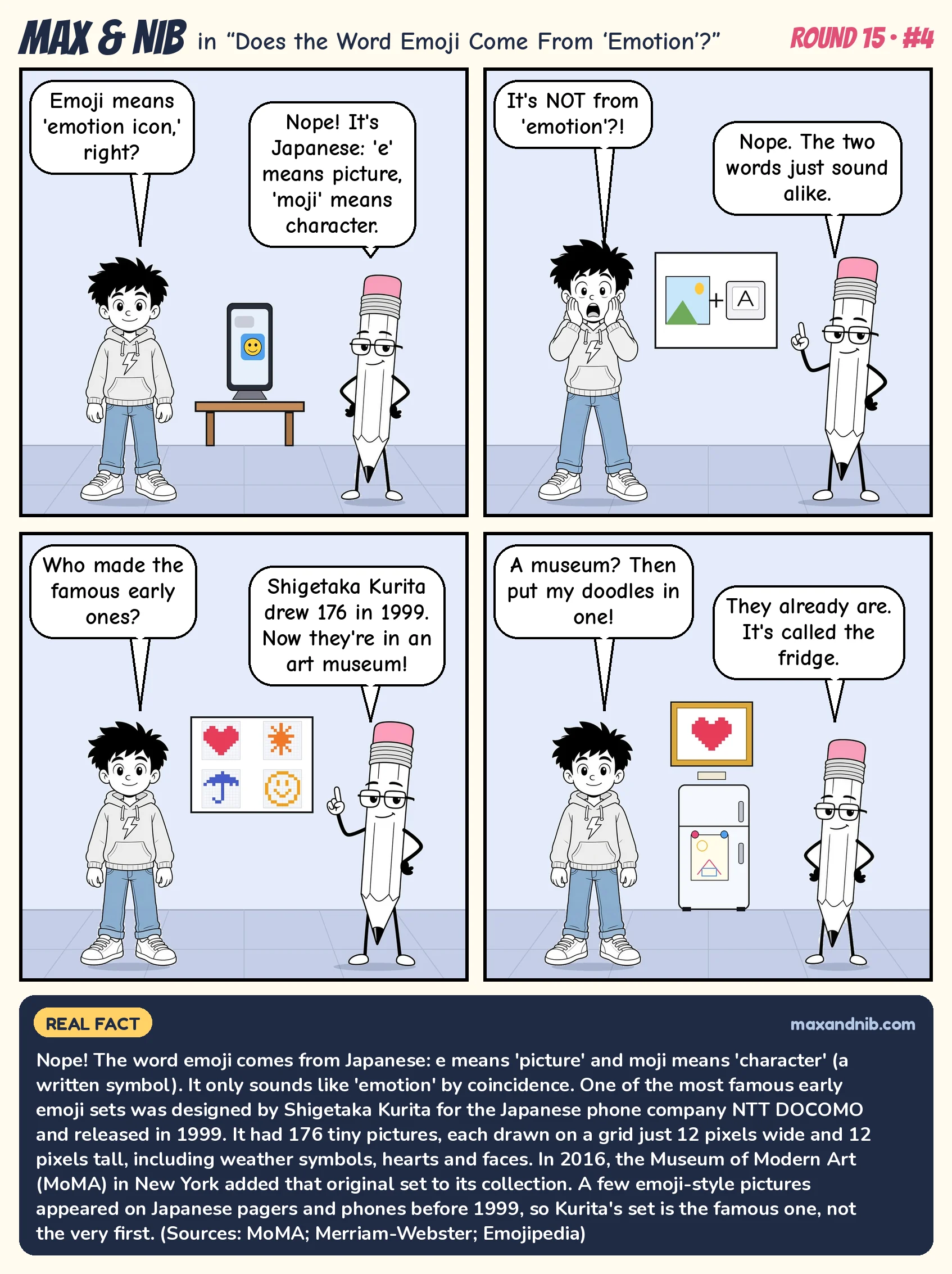
Max, next to a phone on a stand showing a chat with a smiley, says emoji means emotion icon; Nib says nope, it's Japanese: e means picture and moji means character. Max, shocked, says it's not from emotion; Nib points to a poster of a picture plus a letter key and says nope, the two words just sound alike. Max asks who made the famous early ones; Nib points to a poster of four pixel emoji on tiny grids (a heart, a sun, an umbrella and a smiley) and says Shigetaka Kurita drew 176 of them in 1999 and now they're in an art museum. Next to a gold museum frame holding a pixel heart, above a fridge with a crayon drawing, Max says then put his doodles in a museum too; Nib says they already are, it's called the fridge.
Comic · Tech

Does the Word Emoji Come From ‘Emotion’?

Real fact: Nope! The word emoji comes from Japanese: e means 'picture' and moji means 'character' (a written symbol). It only sounds like 'emotion' by coincidence. One of the most famous early emoji sets was designed by Shigetaka Kurita for the Japanese phone company NTT DOCOMO and released in 1999. It had 176 tiny pictures, each drawn on a grid just 12 pixels wide and 12 pixels tall, including weather symbols, hearts and faces. In 2016, the Museum of Modern Art (MoMA) in New York added that original set to its collection. A few emoji-style pictures appeared on Japanese pagers and phones before 1999, so Kurita's set is the famous one, not the very first. (Sources: MoMA; Merriam-Webster; Emojipedia)

Where this fact comes from