Round 10

The Biggest Fish, Salty Seas & a Melted Candy Bar

Video · 30 sec · all words on screen, works muted

What's the Biggest Fish in the World?

Real fact: The whale shark! Even with "whale" in its name, it's a shark, and sharks are fish. NOAA says whale sharks may grow up to about 40 feet long. A great white shark grows up to about 20 feet, so the biggest whale sharks are about twice as long. Even though it's the biggest fish, a whale shark eats mostly small things, like plankton, small fish and squid, which it strains out of the water with its huge mouth. (The blue whale is bigger, but whales are mammals, not fish. Sizes are rounded, and a few whale sharks have been reported even longer.)

Where this fact comes from
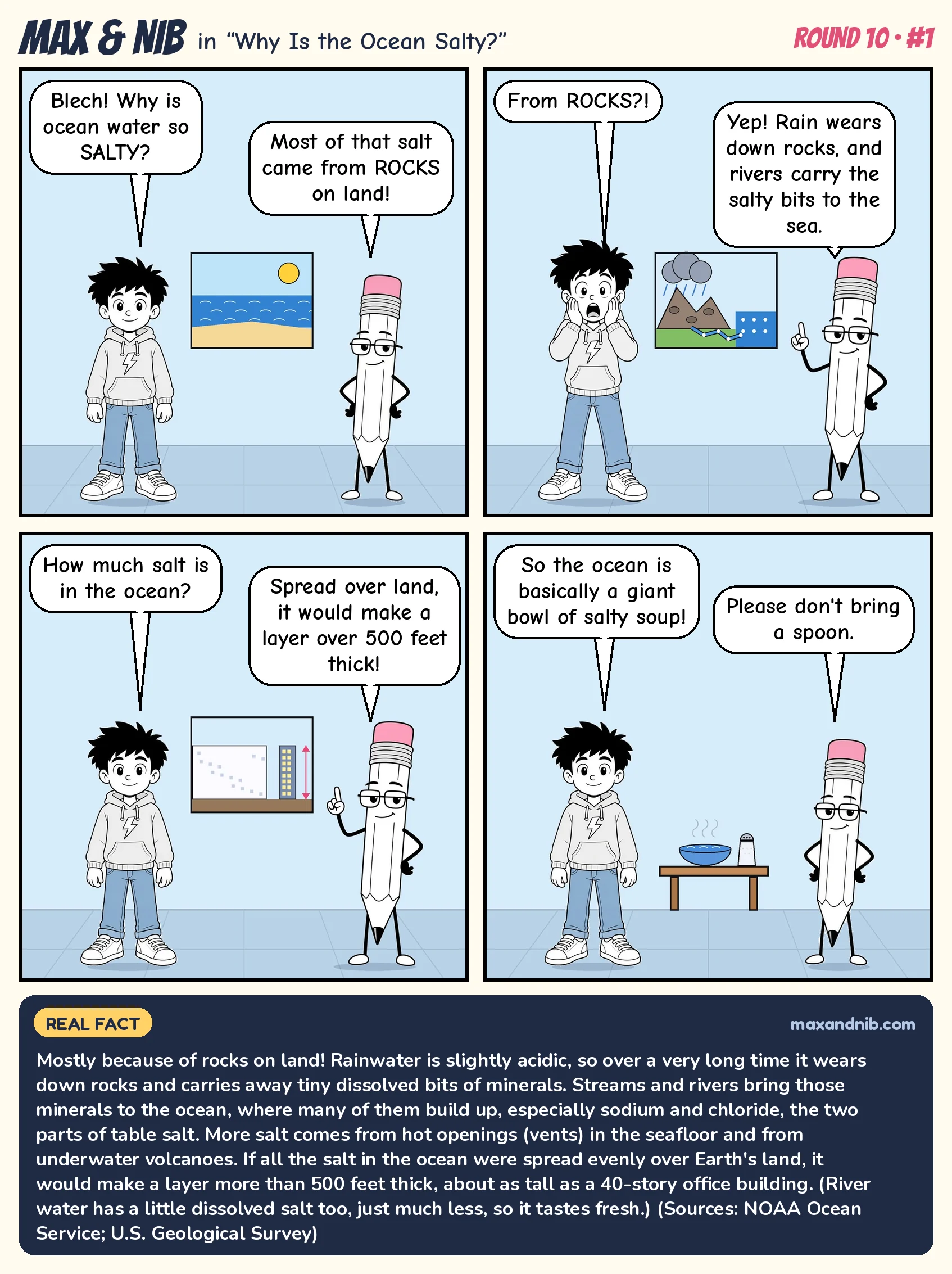
Max, next to a beach poster, asks why ocean water is so salty; Nib says most of that salt came from rocks on land. Max is shocked; Nib points to a chart of a rain cloud over rocky hills and a river carrying little white salty bits into the sea, and says rain wears down rocks and rivers carry the salty bits to the sea. Max asks how much salt is in the ocean; Nib points to a chart of a thick white salt layer covering land, as tall as a skyscraper beside it, and says spread over land it would make a layer over 500 feet thick. Next to a table with a bowl of soup and a salt shaker, Max says the ocean is basically a giant bowl of salty soup; Nib says please don't bring a spoon.
Comic · Earth & Geography

Why Is the Ocean Salty?

Real fact: Mostly because of rocks on land! Rainwater is slightly acidic, so over a very long time it wears down rocks and carries away tiny dissolved bits of minerals. Streams and rivers bring those minerals to the ocean, where many of them build up, especially sodium and chloride, the two parts of table salt. More salt comes from hot openings (vents) in the seafloor and from underwater volcanoes. If all the salt in the ocean were spread evenly over Earth's land, it would make a layer more than 500 feet thick, about as tall as a 40-story office building. (River water has a little dissolved salt too, just much less, so it tastes fresh.) (Sources: NOAA Ocean Service; U.S. Geological Survey)

Where this fact comes from
Max, next to a bubble bath with a rubber duck, says his fingers got wrinkly because he soaked up too much water; Nib says not exactly, his nerves are behind those wrinkles. Max is shocked; Nib points to a chart of a smooth fingertip and a wrinkly fingertip with tiny blood vessels squeezing, and says tiny blood vessels in the fingertips squeeze and the skin folds up. Max asks why his body would want prune fingers; Nib points to a chart of a wrinkly fingertip next to a treaded tire in the rain, and says scientists think wrinkles may help you grip wet things, like tire treads. Next to a towel rack, with a bar of soap flying through the air, Max says he'll never drop the soap again; Nib says catching it is easy, using it is the hard part.
Comic · Human Body

Why Do Your Fingers Get Wrinkly in Water?

Real fact: Not just from soaking up water! For a long time, people thought wrinkly "prune fingers" came only from skin soaking up water. But doctors have known since the 1930s that fingers with damaged nerves don't wrinkle in water. Many scientists now say wrinkling is mostly your nervous system at work: it makes tiny blood vessels under your fingertip skin narrow (squeeze), and the skin pulls into folds. Why would that happen? Some scientists think the wrinkles work like tire treads to help you grip wet things. One 2013 study found people moved wet marbles faster with wrinkly fingers, but a 2014 study found no difference, so the "why" is still being studied. (Sources: Smithsonian Magazine; Scientific American; Wilder-Smith & Chow, Muscle & Nerve, 2003)

Where this fact comes from
Max, next to a poster of a castle with two flags, says the Hundred Years' War lasted 100 years; Nib says not so fast, it lasted about 116 years. Max is shocked; Nib points to a timeline chart where a bracket for 100 years stops short and the war bar keeps going, and says England and France fought on and off from 1337 to 1453. Max asks if they fought for 116 years straight; Nib points to a timeline split into war sections with crossed swords and peaceful sections with doves, and says there were long breaks of peace between the battles. Next to a tall pile of homework papers and a wall clock, Max says his homework is his own Hundred Years' War; Nib says just like the real one, it's running way over time.
Comic · History

Did the Hundred Years' War Last 100 Years?

Real fact: No! The Hundred Years' War between England and France lasted about 116 years, from 1337 to 1453. It wasn't one nonstop war. It was a long series of wars and battles with truces (long breaks with no fighting) in between, and it lasted through the reigns of five English kings and five French kings. The big question was who had the right to be king of France. (Historians use 1337 and 1453 as the start and end dates, which is why you'll see 116 years.) (Sources: Britannica Kids; Guinness World Records)

Where this fact comes from
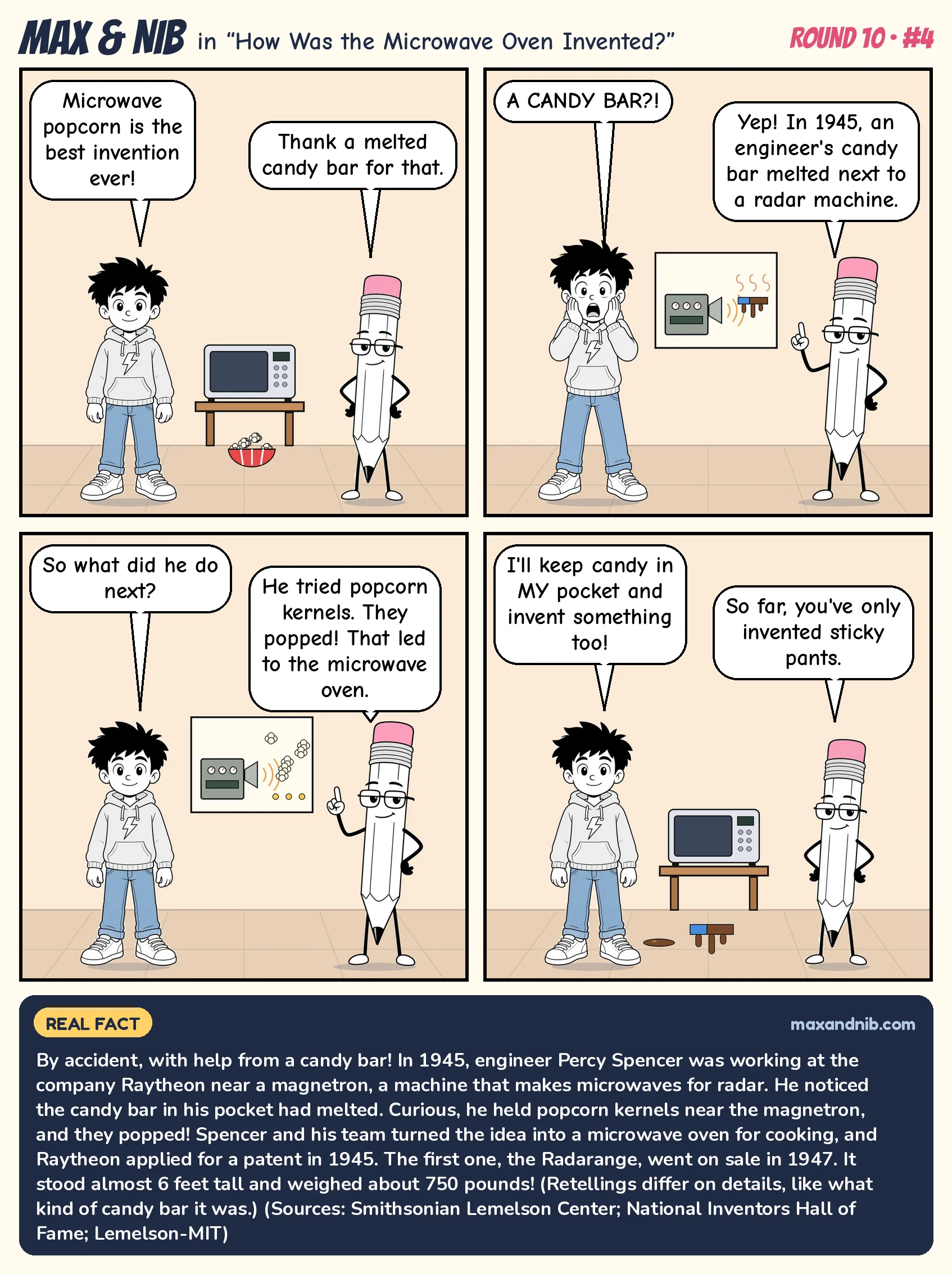
Max, next to a microwave on a table and a bowl of popcorn, says microwave popcorn is the best invention ever; Nib says to thank a melted candy bar for that. Max is shocked; Nib points to a chart of a 1940s radar machine sending waves at a melting candy bar, and says in 1945 an engineer's candy bar melted next to a radar machine. Max asks what he did next; Nib points to a chart of the radar machine sending waves at popcorn kernels that are popping, and says he tried popcorn kernels, they popped, and that led to the microwave oven. Next to a melted candy bar and a chocolate puddle on the floor, Max says he'll keep candy in his pocket and invent something too; Nib says so far he's only invented sticky pants.
Comic · Tech & Inventions

How Was the Microwave Oven Invented?

Real fact: By accident, with help from a candy bar! In 1945, engineer Percy Spencer was working at the company Raytheon near a magnetron, a machine that makes microwaves for radar. He noticed the candy bar in his pocket had melted. Curious, he held popcorn kernels near the magnetron, and they popped! Spencer and his team turned the idea into a microwave oven for cooking, and Raytheon applied for a patent in 1945. The first one, the Radarange, went on sale in 1947. It stood almost 6 feet tall and weighed about 750 pounds! (Retellings differ on details, like what kind of candy bar it was.) (Sources: Smithsonian Lemelson Center; National Inventors Hall of Fame; Lemelson-MIT)

Where this fact comes from