Round 11

The Biggest Planet, Gray Flamingos & a Three-Day Feast

Video · 29 sec · all words on screen, works muted

What's the Biggest Planet in the Solar System?

Real fact: Jupiter! NASA says Jupiter is about 88,846 miles wide at its equator, while Earth is about 7,926 miles wide, so Jupiter is about 11 times wider than Earth. NASA puts it this way: if Earth were the size of a grape, Jupiter would be about as big as a basketball. Jupiter is a gas giant, made mostly of swirling gases and liquids, so it doesn't have a true surface. A spacecraft would have nowhere to land! (Widths are measured at each planet's equator and rounded.)

Where this fact comes from
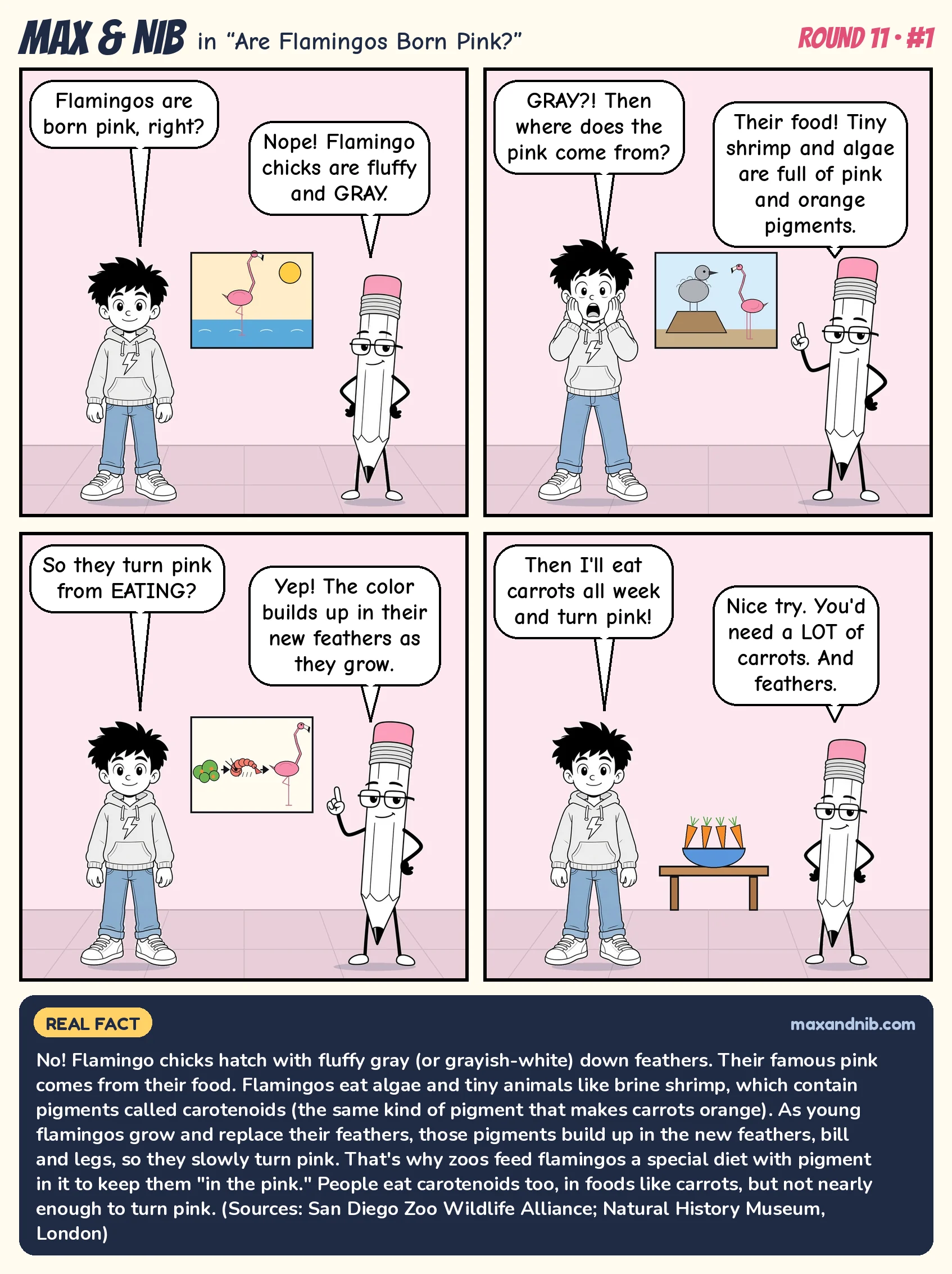
Max, next to a poster of a pink flamingo standing on one leg in a lagoon, says flamingos are born pink; Nib says nope, flamingo chicks are fluffy and gray. Max is shocked; Nib points to a poster of a fluffy gray chick on a mud nest next to a pink grown-up flamingo, and says their food, tiny shrimp and algae, is full of pink and orange pigments. Max asks if they turn pink from eating; Nib points to a chart with arrows from green algae to a pink shrimp to a pink flamingo, and says the color builds up in their new feathers as they grow. Next to a table with a bowl of carrots, Max says he'll eat carrots all week and turn pink; Nib says nice try, he'd need a lot of carrots, and feathers.
Comic · Animals

Are Flamingos Born Pink?

Real fact: No! Flamingo chicks hatch with fluffy gray (or grayish-white) down feathers. Their famous pink comes from their food. Flamingos eat algae and tiny animals like brine shrimp, which contain pigments called carotenoids (the same kind of pigment that makes carrots orange). As young flamingos grow and replace their feathers, those pigments build up in the new feathers, bill and legs, so they slowly turn pink. That's why zoos feed flamingos a special diet with pigment in it to keep them "in the pink." People eat carotenoids too, in foods like carrots, but not nearly enough to turn pink. (Sources: San Diego Zoo Wildlife Alliance; Natural History Museum, London)

Where this fact comes from
Max, next to a poster of a giraffe beside an acacia tree, says a giraffe's neck must have a hundred bones; Nib says nope, just seven, the same as his. Max is shocked; Nib points to a chart of a person's neck with seven small bones next to a giraffe's neck with seven long bones, and says almost all mammals have seven neck bones, even mice. Max asks how its neck is so long; Nib points to a chart of one long neck bone next to a ruler, and says each giraffe neck bone can be over 10 inches long. Under a high shelf with a cookie jar, next to a step stool, Max says he's stretching his neck to reach the cookies; Nib says seven bones won't stretch, try the stool.
Comic · Human Body

Does a Giraffe Have More Neck Bones Than You?

Real fact: No! A giraffe has seven neck bones (vertebrae), exactly the same number as you. The difference is size: each of a giraffe's neck bones can be more than 10 inches (25 cm) long, while yours are small. In fact, almost all mammals have seven neck bones, from tiny mice to giraffes. (A few, like sloths and manatees, are rare exceptions.) (Sources: San Diego Zoo Wildlife Alliance; Natural History Museum, London; Lincoln Park Zoo)

Where this fact comes from
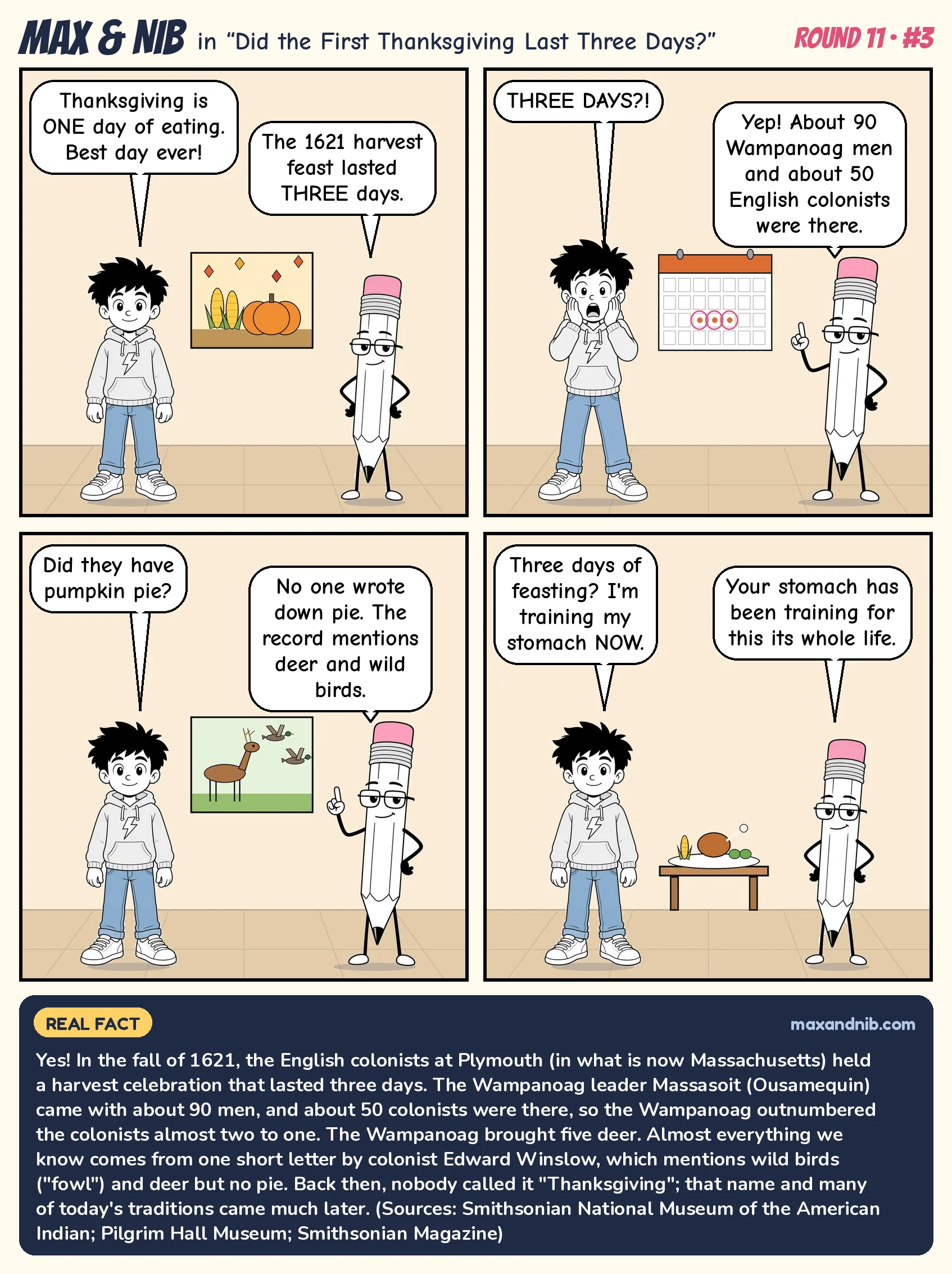
Max, next to a harvest poster of corn, a pumpkin and falling leaves, says Thanksgiving is one day of eating; Nib says the 1621 harvest feast lasted three days. Max is shocked; Nib points to a big wall calendar with three days in a row circled, and says about 90 Wampanoag men and about 50 English colonists were there. Max asks if they had pumpkin pie; Nib points to a poster of a deer and wild birds flying, and says no one wrote down pie, the record mentions deer and wild birds. Next to a table with a plate of corn, a drumstick and greens, Max says three days of feasting, he's training his stomach now; Nib says his stomach has been training for this its whole life.
Comic · History

Did the First Thanksgiving Last Three Days?

Real fact: Yes! In the fall of 1621, the English colonists at Plymouth (in what is now Massachusetts) held a harvest celebration that lasted three days. The Wampanoag leader Massasoit (Ousamequin) came with about 90 men, and about 50 colonists were there, so the Wampanoag outnumbered the colonists almost two to one. The Wampanoag brought five deer. Almost everything we know comes from one short letter by colonist Edward Winslow, which mentions wild birds ("fowl") and deer but no pie. Back then, nobody called it "Thanksgiving"; that name and many of today's traditions came much later. (Sources: Smithsonian National Museum of the American Indian; Pilgrim Hall Museum; Smithsonian Magazine)

Where this fact comes from
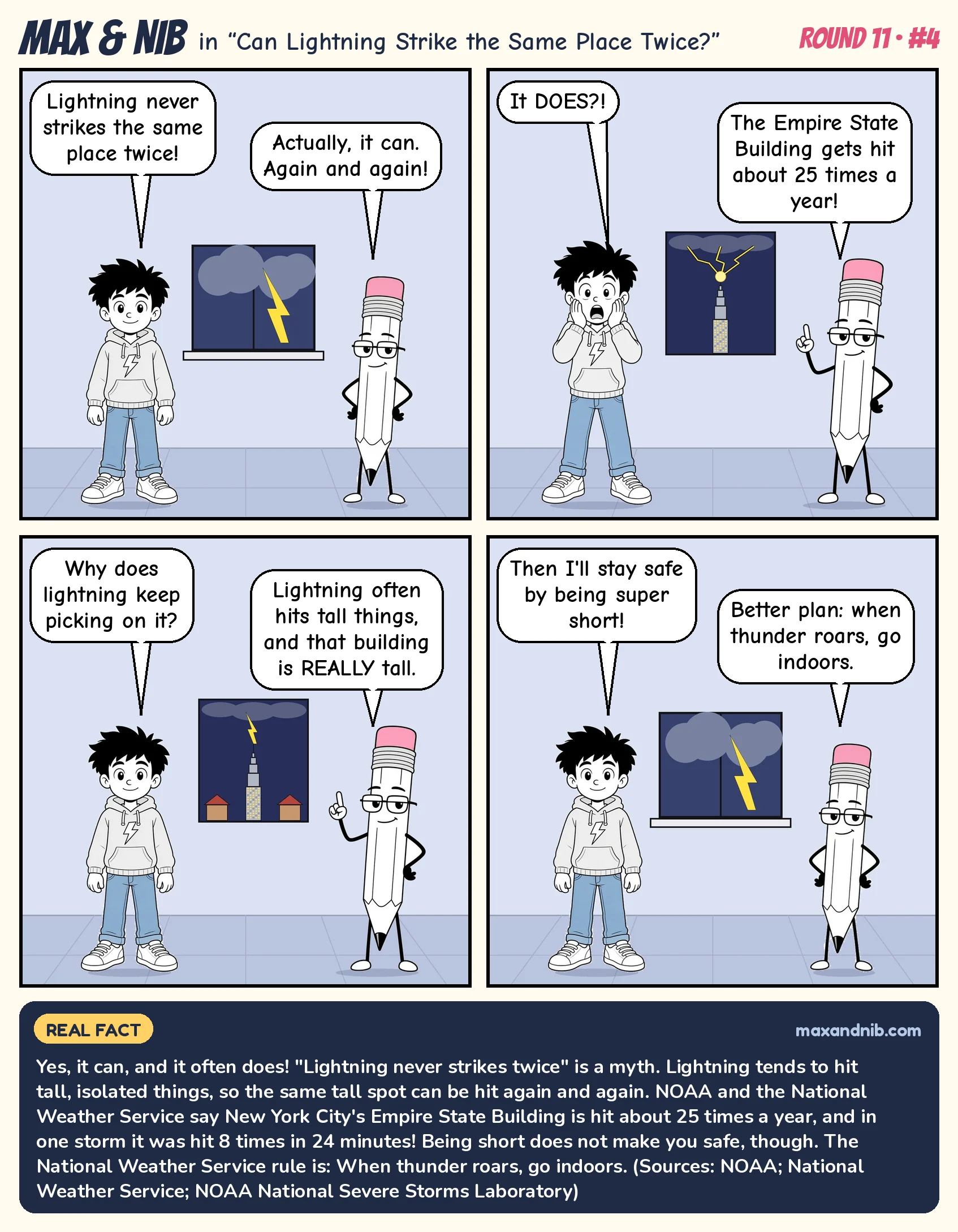
Max, next to a window showing a stormy sky with a lightning bolt, says lightning never strikes the same place twice; Nib says actually it can, again and again. Max is shocked; Nib points to a night poster of a very tall skyscraper with lightning bolts hitting its spire, and says the Empire State Building gets hit about 25 times a year. Max asks why lightning keeps picking on it; Nib points to a poster of the tall skyscraper next to small houses, with a bolt hitting the skyscraper, and says lightning often hits tall things and that building is really tall. Next to the stormy window, Max says he'll stay safe by being super short; Nib says better plan, when thunder roars, go indoors.
Comic · Earth & Weather

Can Lightning Strike the Same Place Twice?

Real fact: Yes, it can, and it often does! "Lightning never strikes twice" is a myth. Lightning tends to hit tall, isolated things, so the same tall spot can be hit again and again. NOAA and the National Weather Service say New York City's Empire State Building is hit about 25 times a year, and in one storm it was hit 8 times in 24 minutes! Being short does not make you safe, though. The National Weather Service rule is: When thunder roars, go indoors. (Sources: NOAA; National Weather Service; NOAA National Severe Storms Laboratory)

Where this fact comes from