Round 12

The Biggest Ocean, Owl Head Spins & Ben Franklin's Turkey

Video · 30 sec · all words on screen, works muted

What's the Biggest Ocean in the World?

Real fact: The Pacific! NOAA says the Pacific Ocean covers about 63 million square miles, while the Atlantic, the second-biggest ocean, covers about 41 million square miles. That makes the Pacific about 1.5 times bigger than the Atlantic. It's so big that all of the world's continents could fit inside it! The Pacific is also the deepest ocean and holds more than half of the free water on Earth. (Areas are rounded; different sources draw ocean borders a little differently, so their numbers vary a bit.)
Where this fact comes from
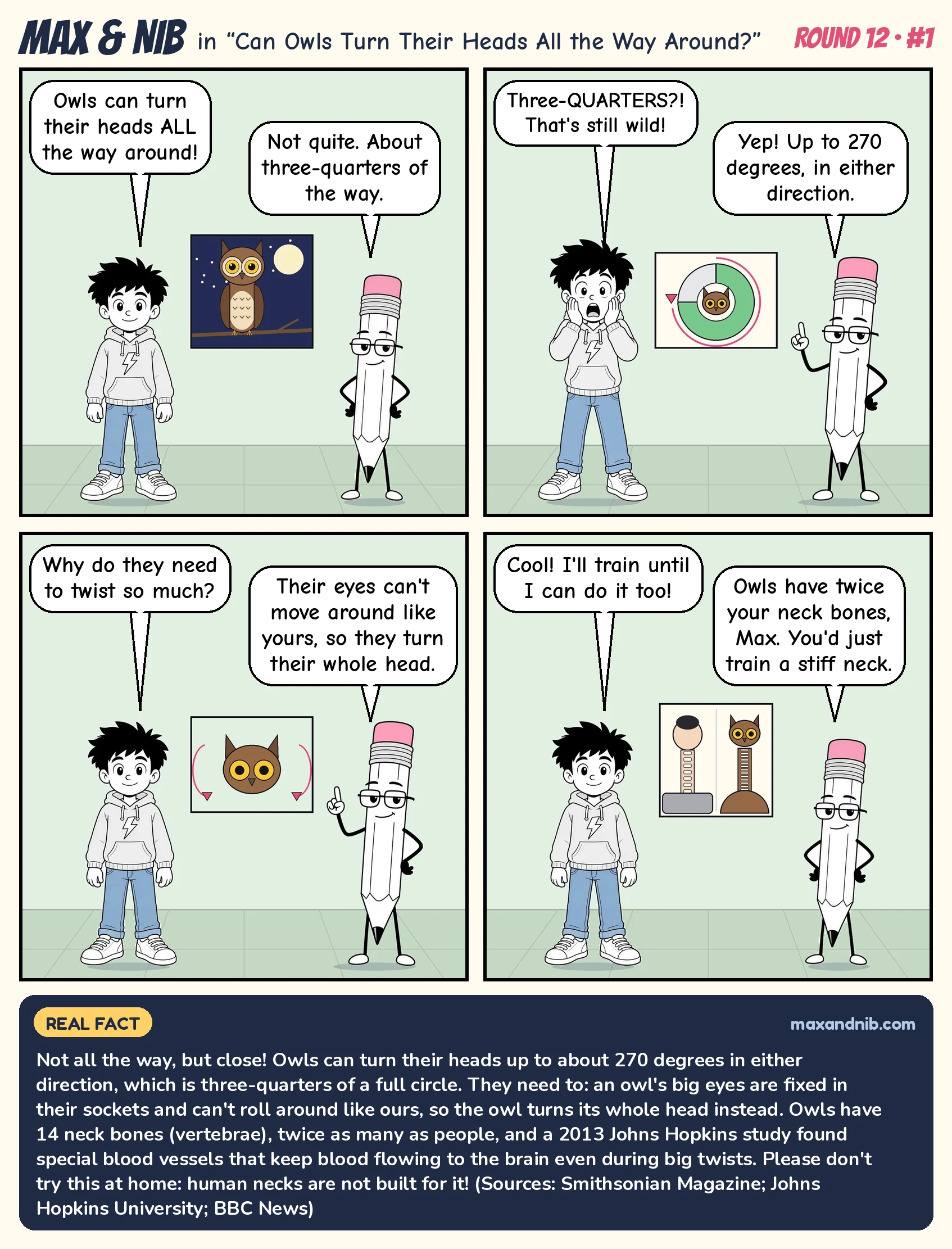
Max, next to a night poster of an owl on a branch under the moon, says owls can turn their heads all the way around; Nib says not quite, about three-quarters of the way. Max is shocked; Nib points to a chart of a circle with three-quarters filled in around an owl face, and says up to 270 degrees, in either direction. Max asks why they need to twist so much; Nib points to a chart of an owl face with curved arrows on both sides, and says their eyes can't move around like his, so they turn their whole head. Next to a chart comparing a person's neck with 7 bones and an owl's neck with 14 bones, Max says he'll train until he can do it too; Nib says owls have twice his neck bones, so he'd just train a stiff neck.
Comic · Animals

Can Owls Turn Their Heads All the Way Around?

Real fact: Not all the way, but close! Owls can turn their heads up to about 270 degrees in either direction, which is three-quarters of a full circle. They need to: an owl's big eyes are fixed in their sockets and can't roll around like ours, so the owl turns its whole head instead. Owls have 14 neck bones (vertebrae), twice as many as people, and a 2013 Johns Hopkins study found special blood vessels that keep blood flowing to the brain even during big twists. Please don't try this at home: human necks are not built for it! (Sources: Smithsonian Magazine; Johns Hopkins University; BBC News)

Where this fact comes from
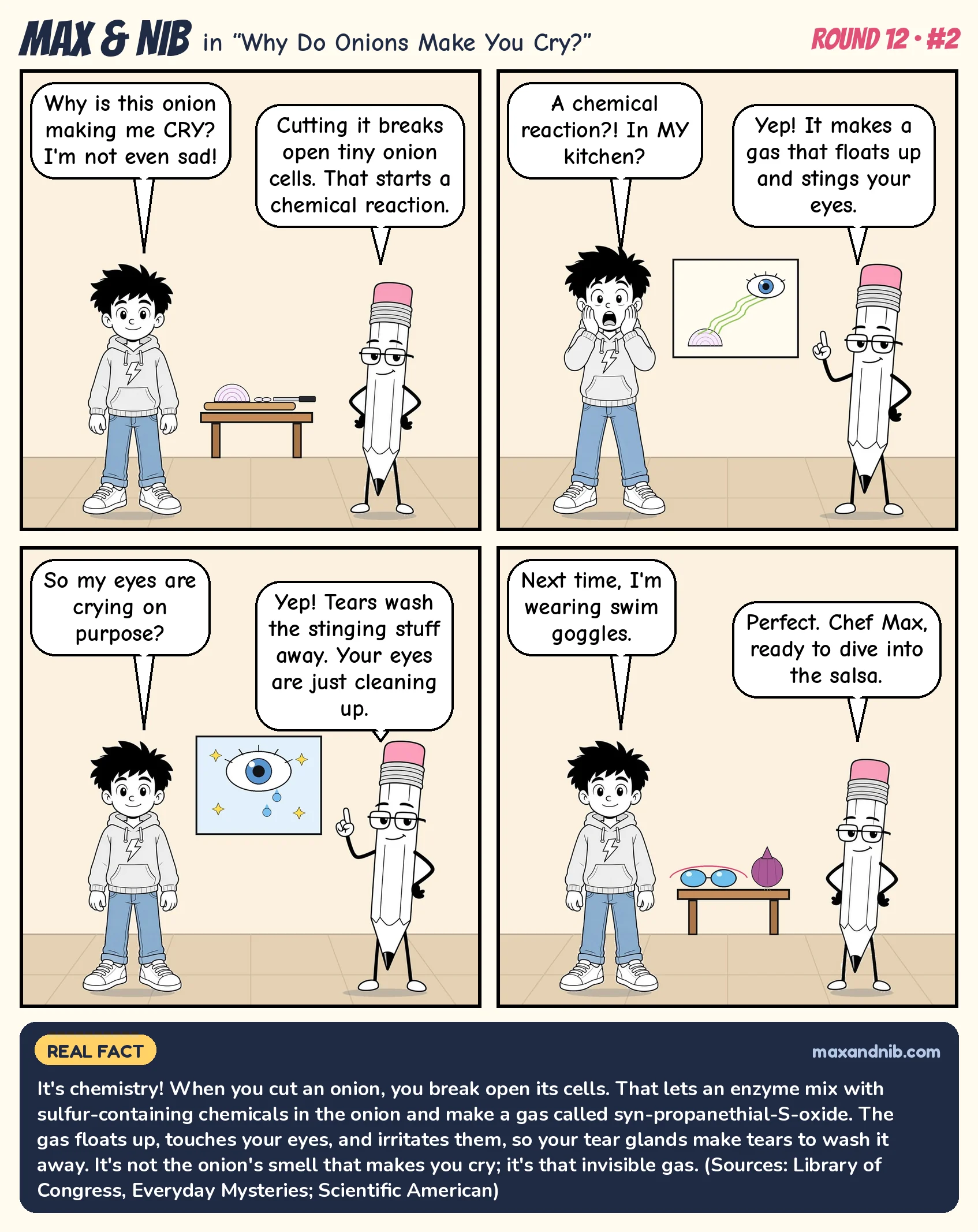
Max, next to a table with a cutting board, a cut onion and a knife, asks why the onion is making him cry when he's not even sad; Nib says cutting it breaks open tiny onion cells, which starts a chemical reaction. Max is shocked; Nib points to a chart of a cut onion giving off wavy gas that floats up to an eye, and says it makes a gas that floats up and stings your eyes. Max asks if his eyes are crying on purpose; Nib points to a chart of an eye with tears and sparkles, and says tears wash the stinging stuff away, his eyes are just cleaning up. Next to a table with swim goggles and an onion, Max says next time he's wearing swim goggles; Nib says perfect, Chef Max, ready to dive into the salsa.
Comic · Human Body

Why Do Onions Make You Cry?

Real fact: It's chemistry! When you cut an onion, you break open its cells. That lets an enzyme mix with sulfur-containing chemicals in the onion and make a gas called syn-propanethial-S-oxide. The gas floats up, touches your eyes, and irritates them, so your tear glands make tears to wash it away. It's not the onion's smell that makes you cry; it's that invisible gas. (Sources: Library of Congress, Everyday Mysteries; Scientific American)

Where this fact comes from
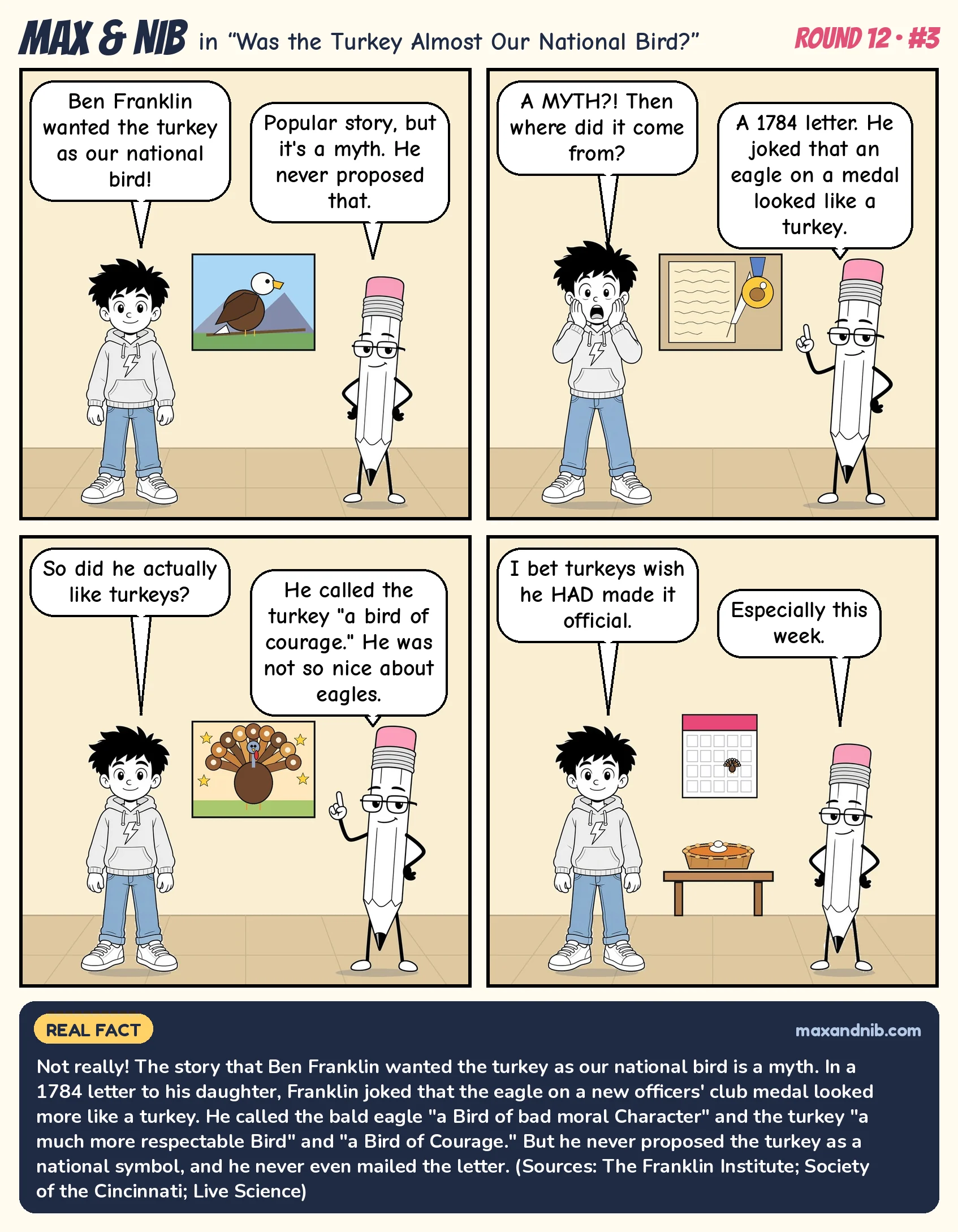
Max, next to a poster of a bald eagle perched on a branch, says Ben Franklin wanted the turkey as our national bird; Nib says popular story, but it's a myth, he never proposed that. Max is shocked; Nib points to a poster of an old letter with a quill pen and a round medal with a chubby bird, and says it came from a 1784 letter where he joked that an eagle on a medal looked like a turkey. Max asks if he actually liked turkeys; Nib points to a poster of a wild turkey with gold stars, and says he called the turkey a bird of courage and was not so nice about eagles. Next to a wall calendar with a little turkey drawn on it and a pumpkin pie on a table, Max says he bets turkeys wish he had made it official; Nib says especially this week.
Comic · History

Was the Turkey Almost Our National Bird?

Real fact: Not really! The story that Ben Franklin wanted the turkey as our national bird is a myth. In a 1784 letter to his daughter, Franklin joked that the eagle on a new officers' club medal looked more like a turkey. He called the bald eagle "a Bird of bad moral Character" and the turkey "a much more respectable Bird" and "a Bird of Courage." But he never proposed the turkey as a national symbol, and he never even mailed the letter. (Sources: The Franklin Institute; Society of the Cincinnati; Live Science)

Where this fact comes from
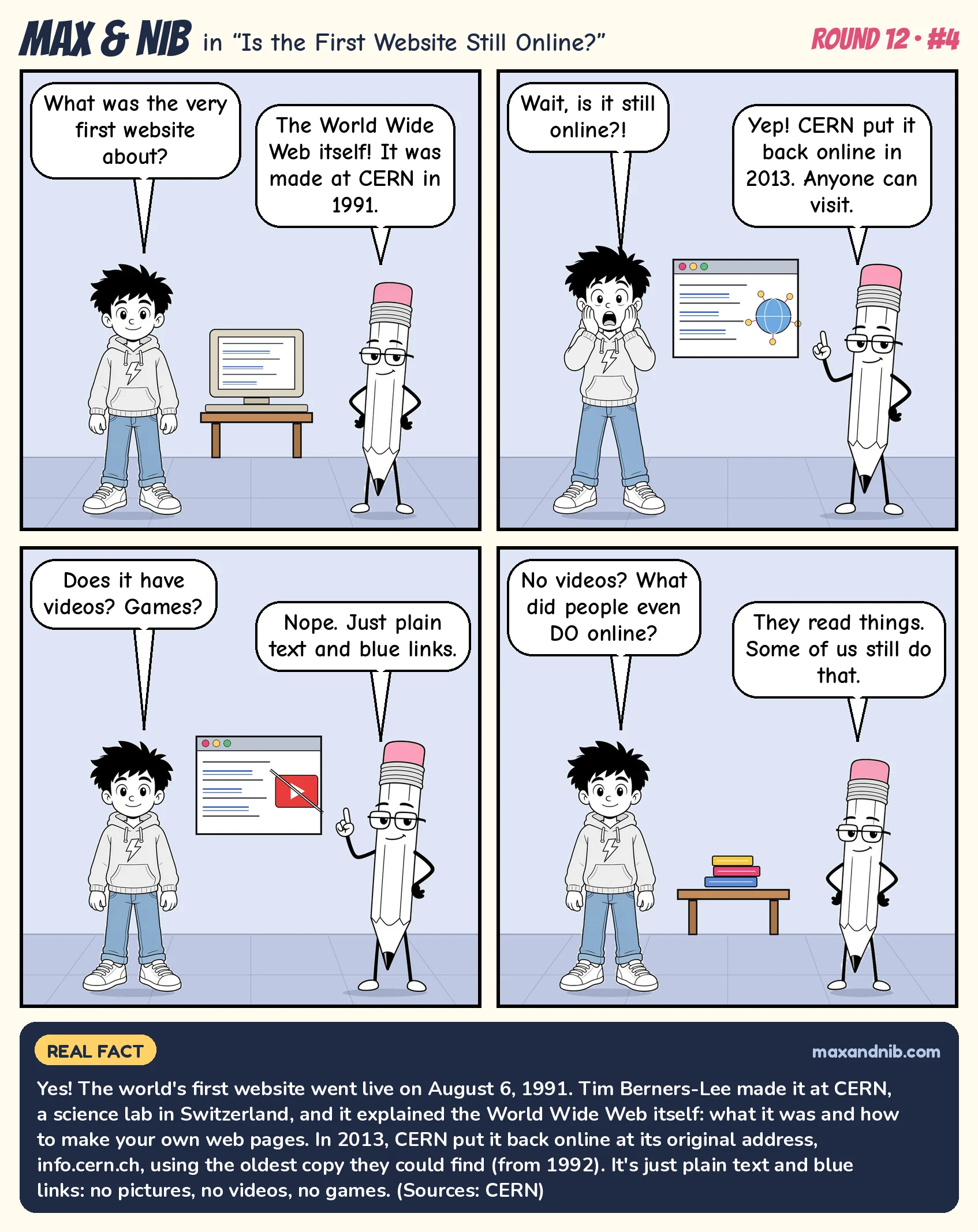
Max, next to a table with a chunky old computer showing a plain text web page, asks what the very first website was about; Nib says the World Wide Web itself, made at CERN in 1991. Max is shocked; Nib points to a poster of an old browser window with text lines, blue links and a little globe with connection lines, and says CERN put it back online in 2013 and anyone can visit. Max asks if it has videos or games; Nib points to a poster of a browser window with text and blue links and a crossed-out video play button, and says nope, just plain text and blue links. Next to a table with a stack of books, Max asks what people even did online with no videos; Nib says they read things, and some of us still do that.
Comic · Technology

Is the First Website Still Online?

Real fact: Yes! The world's first website went live on August 6, 1991. Tim Berners-Lee made it at CERN, a science lab in Switzerland, and it explained the World Wide Web itself: what it was and how to make your own web pages. In 2013, CERN put it back online at its original address, info.cern.ch, using the oldest copy they could find (from 1992). It's just plain text and blue links: no pictures, no videos, no games. (Sources: CERN)

Where this fact comes from