Round 13

The Biggest Bird, Starfish Eyes & the Sleepy Turkey Myth

Video · 30 sec · all words on screen, works muted

What's the Biggest Bird in the World?

Real fact: The ostrich! It's the tallest and heaviest bird alive. The Smithsonian's National Zoo says an adult ostrich can stand up to 9 feet tall and weigh 200 to 300 pounds. The emu, the second-biggest bird, stands up to about 6.2 feet tall (San Diego Zoo), so the tallest ostriches are almost 3 feet taller. Ostriches can't fly, but they lay the biggest eggs of any living bird: about 3 pounds each, as heavy as about 24 chicken eggs! (Heights are for the tallest adults; females and many males are shorter.)
Where this fact comes from
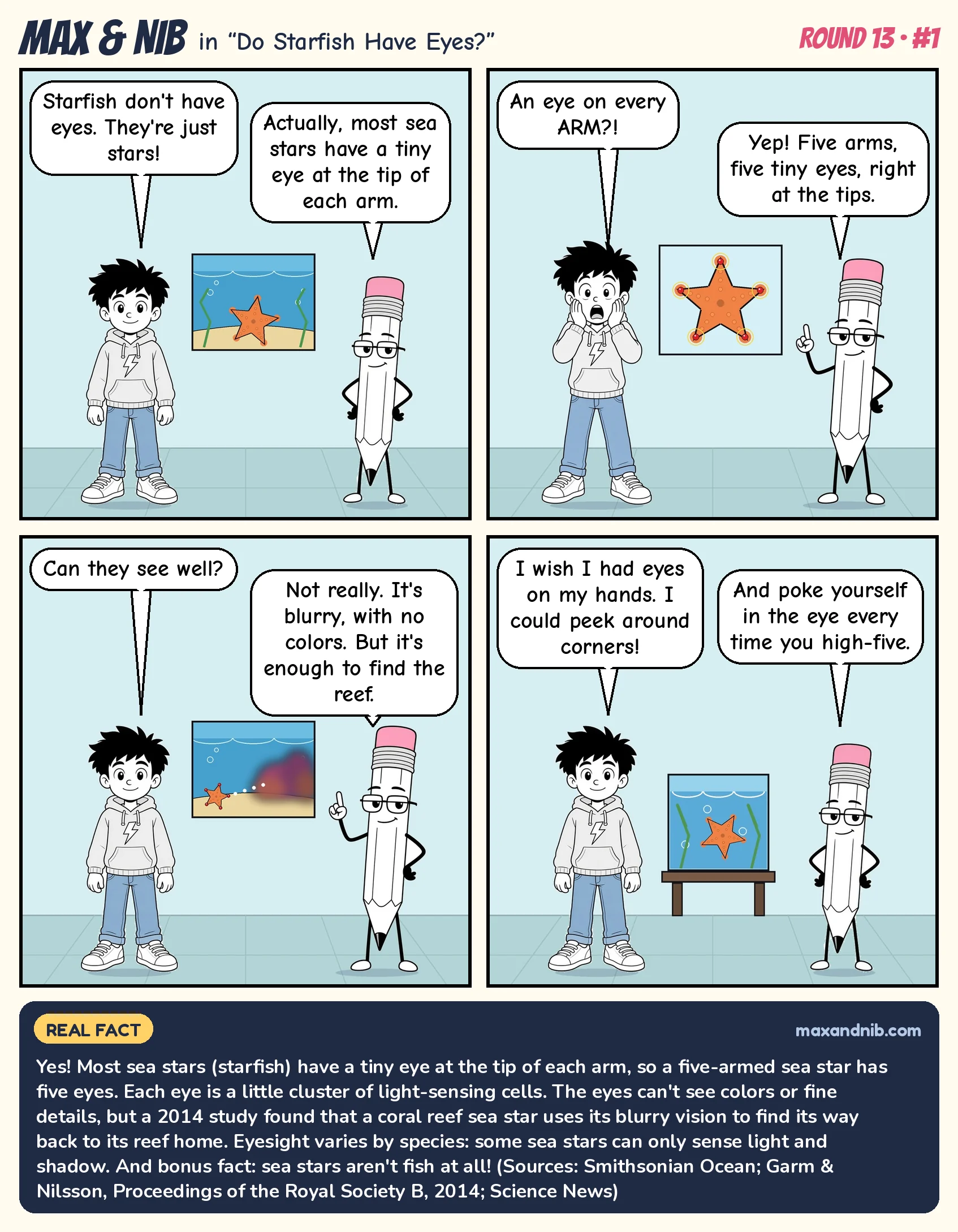
Max, next to an underwater poster of an orange sea star on the sand, says starfish don't have eyes, they're just stars; Nib says most sea stars actually have a tiny eye at the tip of each arm. Max is shocked; Nib points to a chart of a big sea star with a yellow ring around the little red eye at the end of each arm, and says five arms, five tiny eyes, right at the tips. Max asks if they can see well; Nib points to an underwater poster of a small sea star following a dotted path toward a blurry coral reef, and says not really, it's blurry with no colors, but it's enough to find the reef. Next to an aquarium with a sea star on the glass, Max says he wishes he had eyes on his hands to peek around corners; Nib says he'd poke himself in the eye every time he high-fives.
Comic · Animals

Do Starfish Have Eyes?

Real fact: Yes! Most sea stars (starfish) have a tiny eye at the tip of each arm, so a five-armed sea star has five eyes. Each eye is a little cluster of light-sensing cells. The eyes can't see colors or fine details, but a 2014 study found that a coral reef sea star uses its blurry vision to find its way back to its reef home. Eyesight varies by species: some sea stars can only sense light and shadow. And bonus fact: sea stars aren't fish at all! (Sources: Smithsonian Ocean; Garm & Nilsson, Proceedings of the Royal Society B, 2014; Science News)

Where this fact comes from
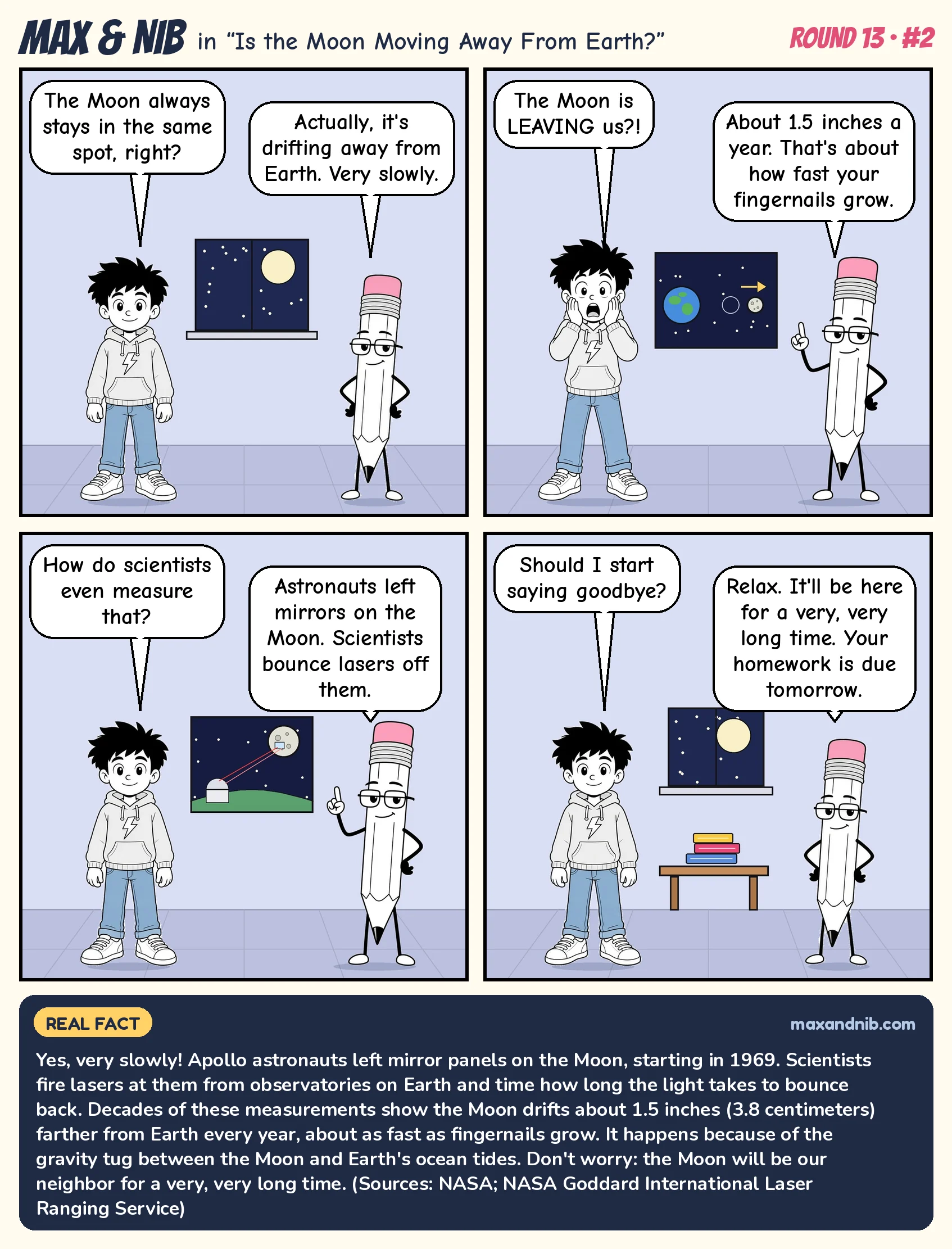
Max, next to a night window with a big full Moon, says the Moon always stays in the same spot; Nib says it's actually drifting away from Earth, very slowly. Max is shocked; Nib points to a space poster of Earth and the Moon, with a dotted outline where the Moon used to be and an arrow showing it moving away, and says about 1.5 inches a year, about how fast his fingernails grow. Max asks how scientists measure that; Nib points to a poster of an observatory on Earth bouncing a red laser off a little mirror panel on the Moon, and says astronauts left mirrors on the Moon and scientists bounce lasers off them. Next to the Moon window and a stack of books on a table, Max asks if he should start saying goodbye; Nib says relax, it'll be here for a very, very long time, and his homework is due tomorrow.
Comic · Space

Is the Moon Moving Away From Earth?

Real fact: Yes, very slowly! Apollo astronauts left mirror panels on the Moon, starting in 1969. Scientists fire lasers at them from observatories on Earth and time how long the light takes to bounce back. Decades of these measurements show the Moon drifts about 1.5 inches (3.8 centimeters) farther from Earth every year, about as fast as fingernails grow. It happens because of the gravity tug between the Moon and Earth's ocean tides. Don't worry: the Moon will be our neighbor for a very, very long time. (Sources: NASA; NASA Goddard International Laser Ranging Service)

Where this fact comes from
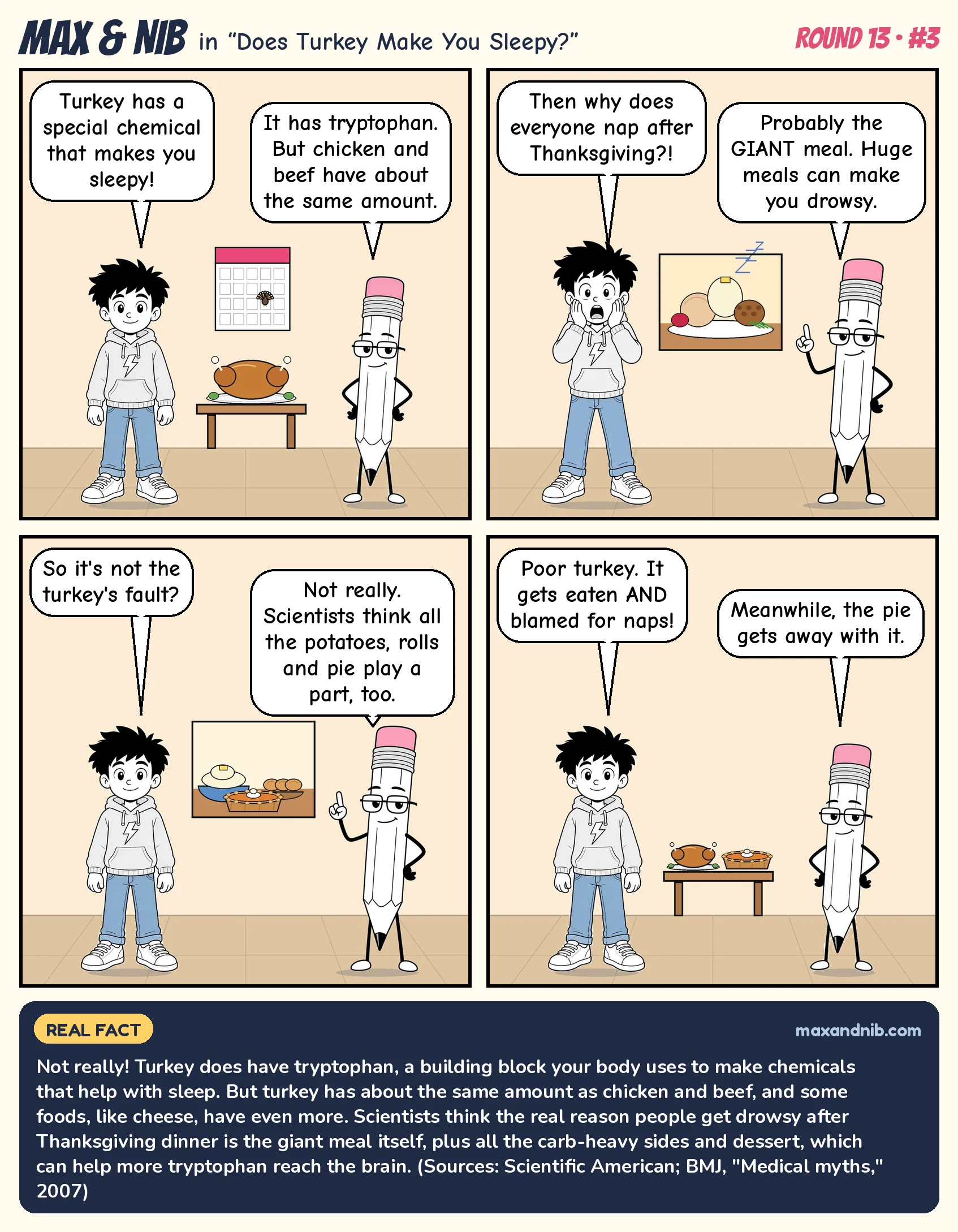
Max, next to a table with a roast turkey and a wall calendar with a little turkey on it, says turkey has a special chemical that makes you sleepy; Nib says it has tryptophan, but chicken and beef have about the same amount. Max is shocked and asks why everyone naps after Thanksgiving; Nib points to a poster of a giant piled-up dinner plate with sleepy z's above it, and says probably the giant meal, huge meals can make you drowsy. Max asks if it's not the turkey's fault; Nib points to a poster of mashed potatoes, a basket of rolls and a pumpkin pie, and says scientists think all the potatoes, rolls and pie play a part, too. Next to a table with a small roast turkey and a pumpkin pie, Max says poor turkey, it gets eaten and blamed for naps; Nib says meanwhile, the pie gets away with it.
Comic · Human Body

Does Turkey Make You Sleepy?

Real fact: Not really! Turkey does have tryptophan, a building block your body uses to make chemicals that help with sleep. But turkey has about the same amount as chicken and beef, and some foods, like cheese, have even more. Scientists think the real reason people get drowsy after Thanksgiving dinner is the giant meal itself, plus all the carb-heavy sides and dessert, which can help more tryptophan reach the brain. (Sources: Scientific American; BMJ, "Medical myths," 2007)

Where this fact comes from
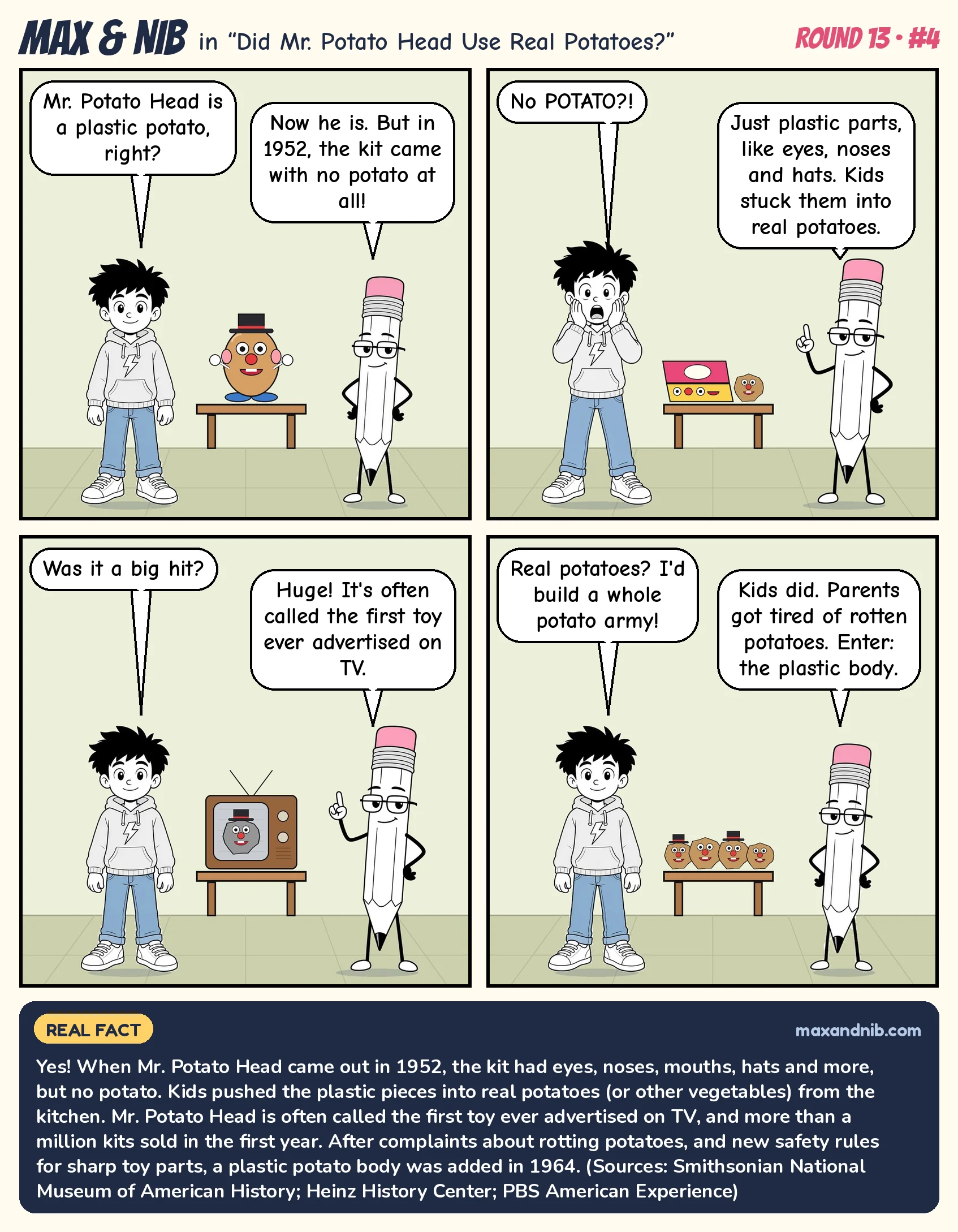
Max, next to a table with a plastic Mr. Potato Head-style toy wearing a hat, asks if Mr. Potato Head is a plastic potato; Nib says now he is, but in 1952 the kit came with no potato at all. Max is shocked; Nib points to an open toy kit box with loose eyes, a nose and lips, next to a real potato wearing a toy face, and says just plastic parts, like eyes, noses and hats, and kids stuck them into real potatoes. Max asks if it was a big hit; Nib points to an old wooden TV with rabbit ears showing a potato with a face, and says it's often called the first toy ever advertised on TV. Next to a table with a row of real potatoes wearing toy faces and hats, Max says he'd build a whole potato army; Nib says kids did, parents got tired of rotten potatoes, enter the plastic body.
Comic · Inventions

Did Mr. Potato Head Use Real Potatoes?

Real fact: Yes! When Mr. Potato Head came out in 1952, the kit had eyes, noses, mouths, hats and more, but no potato. Kids pushed the plastic pieces into real potatoes (or other vegetables) from the kitchen. Mr. Potato Head is often called the first toy ever advertised on TV, and more than a million kits sold in the first year. After complaints about rotting potatoes, and new safety rules for sharp toy parts, a plastic potato body was added in 1964. (Sources: Smithsonian National Museum of American History; Heinz History Center; PBS American Experience)

Where this fact comes from