Round 14

The Tallest Tree, Space Barbecues & a Temporary Tower

Video · 30 sec · all words on screen, works muted

What's the Tallest Tree in the World?

Real fact: A coast redwood! The tallest known living trees on Earth are coast redwoods (Sequoia sempervirens) in California. Save the Redwoods League says they can grow as high as about 380 feet. The current record holder is a secret tree in Redwood National Park nicknamed Hyperion (its exact location is kept quiet to protect it, and the National Park Service has closed the area around it). Giant sequoias, like the General Sherman Tree, are the biggest trees by trunk volume, but they are shorter: the National Park Service lists General Sherman at 274.9 feet tall. So the tallest known redwoods are about 105 feet taller than the biggest sequoia. Heights change a little as trees grow or lose their tops, and a slightly taller redwood could be found later.
Where this fact comes from
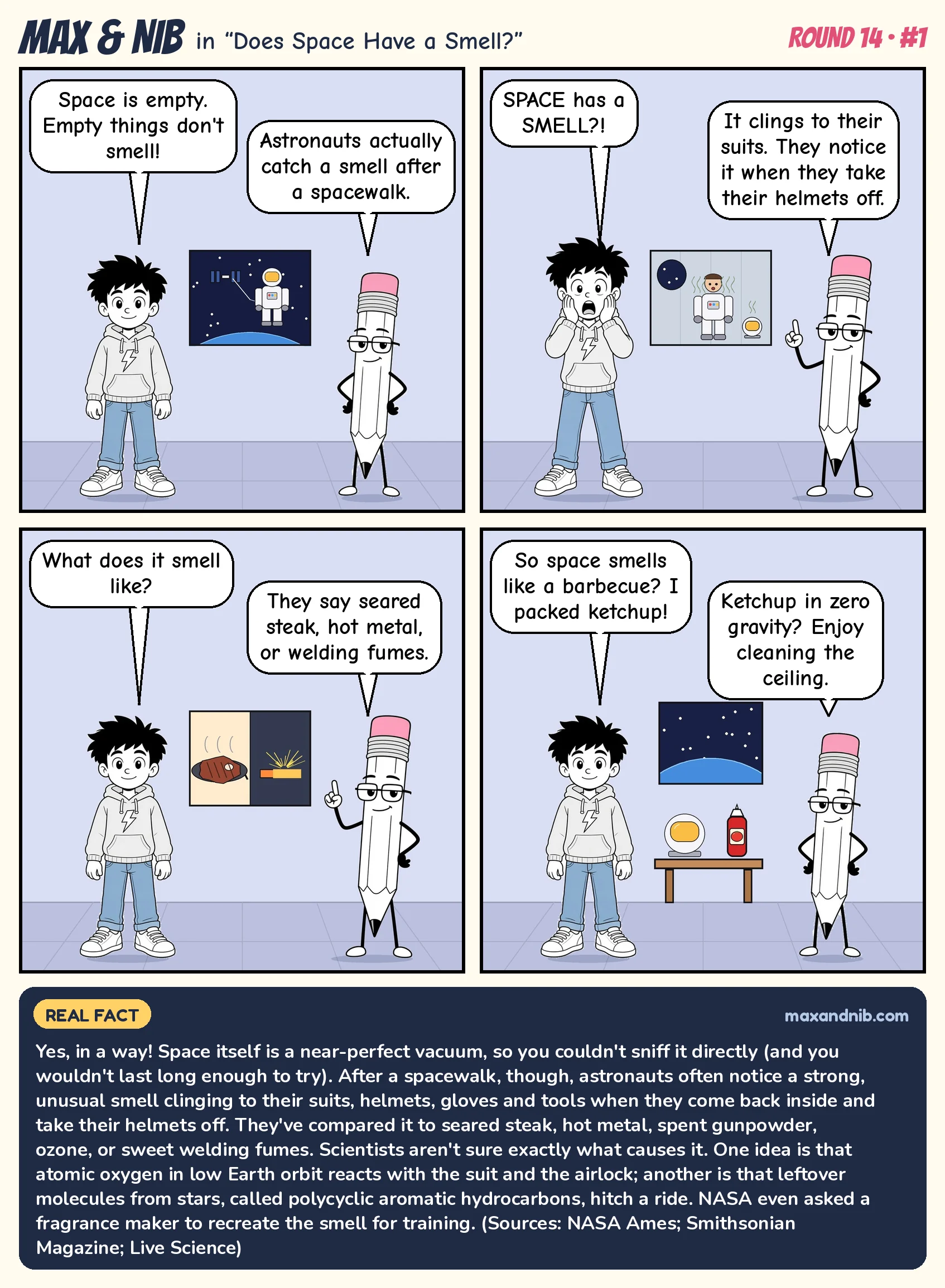
Max, next to a space poster of an astronaut floating on a tether by a space station with Earth's edge below, says space is empty so empty things don't smell; Nib says astronauts actually catch a smell after a spacewalk. Max is shocked; Nib points to a poster of an astronaut inside the station with the helmet off, smell lines rising from the suit, and a helmet sitting nearby, and says the smell clings to their suits and they notice it when they take their helmets off. Max asks what it smells like; Nib points to a split poster of a seared steak in a pan and a glowing hot metal bar throwing sparks, and says they say seared steak, hot metal, or welding fumes. Next to a space poster, a table with an astronaut helmet and a ketchup bottle, Max says so space smells like a barbecue and he packed ketchup; Nib says ketchup in zero gravity, enjoy cleaning the ceiling.
Comic · Space

Does Space Have a Smell?

Real fact: Yes, in a way! Space itself is a near-perfect vacuum, so you couldn't sniff it directly (and you wouldn't last long enough to try). After a spacewalk, though, astronauts often notice a strong, unusual smell clinging to their suits, helmets, gloves and tools when they come back inside and take their helmets off. They've compared it to seared steak, hot metal, spent gunpowder, ozone, or sweet welding fumes. Scientists aren't sure exactly what causes it. One idea is that atomic oxygen in low Earth orbit reacts with the suit and the airlock; another is that leftover molecules from stars, called polycyclic aromatic hydrocarbons, hitch a ride. NASA even asked a fragrance maker to recreate the smell for training. (Sources: NASA Ames; Smithsonian Magazine; Live Science)

Where this fact comes from
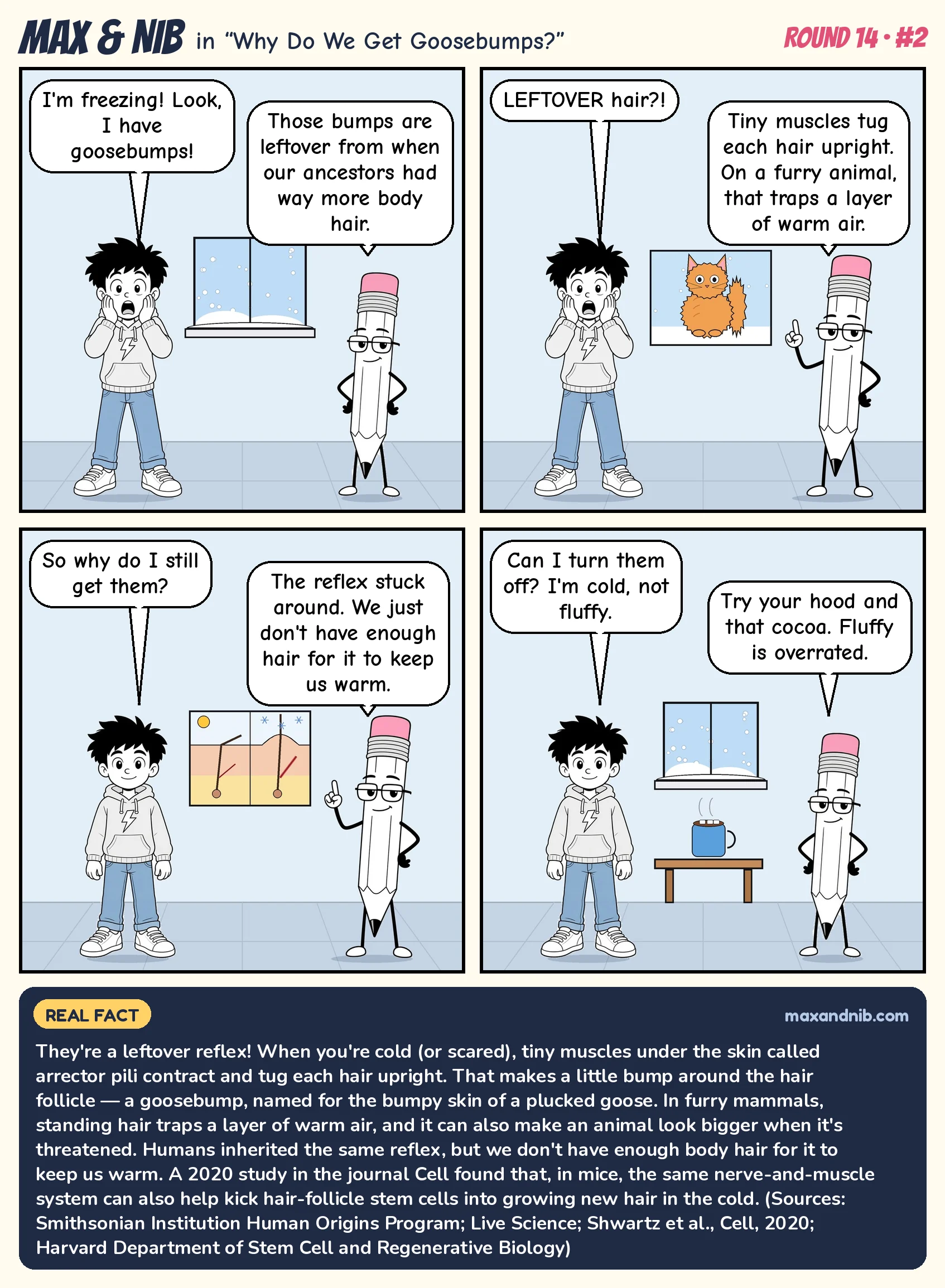
Max, next to a snowy winter window, is shocked and says he's freezing and has goosebumps; Nib says those bumps are leftover from when our ancestors had way more body hair. Max is still shocked; Nib points to a poster of a fluffed-up orange cat sitting in the snow and says tiny muscles tug each hair upright, and on a furry animal that traps a layer of warm air. Max asks why he still gets them; Nib points to a skin diagram, with a flat hair on the warm side and a little muscle pulling a hair straight up into a bump on the cold side, and says the reflex stuck around, we just don't have enough hair for it to keep us warm. Next to the snowy window and a steaming mug of cocoa on a table, Max asks if he can turn them off, he's cold, not fluffy; Nib says try his hood and that cocoa, fluffy is overrated.
Comic · Human Body

Why Do We Get Goosebumps?

Real fact: They're a leftover reflex! When you're cold (or scared), tiny muscles under the skin called arrector pili contract and tug each hair upright. That makes a little bump around the hair follicle — a goosebump, named for the bumpy skin of a plucked goose. In furry mammals, standing hair traps a layer of warm air, and it can also make an animal look bigger when it's threatened. Humans inherited the same reflex, but we don't have enough body hair for it to keep us warm. A 2020 study in the journal Cell found that, in mice, the same nerve-and-muscle system can also help kick hair-follicle stem cells into growing new hair in the cold. (Sources: Smithsonian Institution Human Origins Program; Live Science; Shwartz et al., Cell, 2020; Harvard Department of Stem Cell and Regenerative Biology)

Where this fact comes from
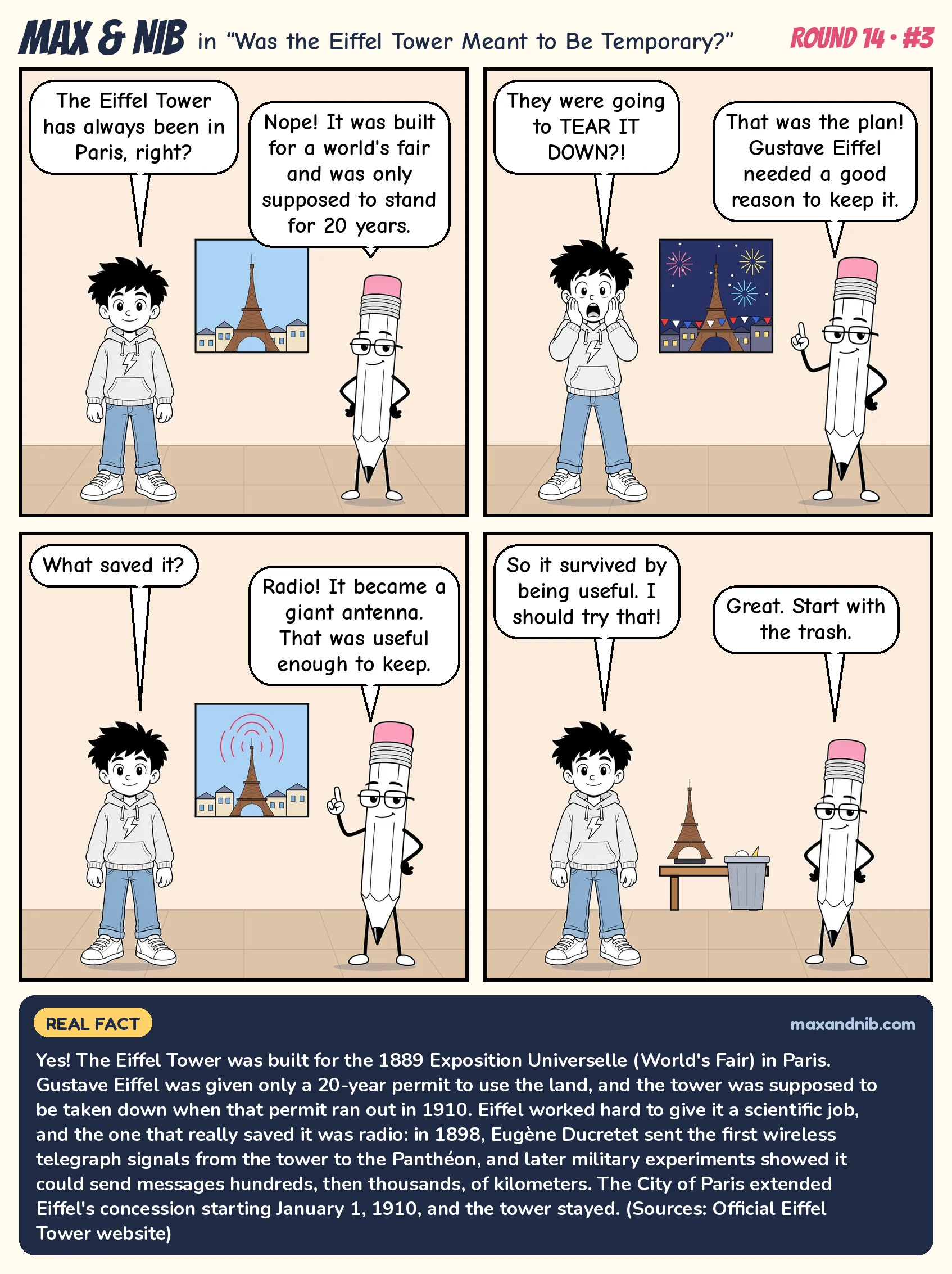
Max, next to a poster of the Eiffel Tower over Paris rooftops, says the Eiffel Tower has always been in Paris; Nib says nope, it was built for a world's fair and was only supposed to stand for 20 years. Max is shocked and asks if they were going to tear it down; Nib points to a night-time poster of the tower with fireworks and colorful bunting and says that was the plan, Gustave Eiffel needed a good reason to keep it. Max asks what saved it; Nib points to a poster of the tower sending out radio waves from its top and says radio, it became a giant antenna, that was useful enough to keep. Next to a table with a little Eiffel Tower souvenir and a trash can, Max says it survived by being useful and he should try that; Nib says great, start with the trash.
Comic · History

Was the Eiffel Tower Meant to Be Temporary?

Real fact: Yes! The Eiffel Tower was built for the 1889 Exposition Universelle (World's Fair) in Paris. Gustave Eiffel was given only a 20-year permit to use the land, and the tower was supposed to be taken down when that permit ran out in 1910. Eiffel worked hard to give it a scientific job, and the one that really saved it was radio: in 1898, Eugène Ducretet sent the first wireless telegraph signals from the tower to the Panthéon, and later military experiments showed it could send messages hundreds, then thousands, of kilometers. The City of Paris extended Eiffel's concession starting January 1, 1910, and the tower stayed. (Sources: Official Eiffel Tower website)

Where this fact comes from
Max, next to a table with three colorful tubs of modeling dough, says Play-Doh was always a toy; Nib says nope, it started as a cleaner for sooty wallpaper. Max is shocked and asks if you wipe walls with it; Nib points to a poster of flowered wallpaper with gray soot smudges and a clean streak where a ball of putty was rolled, and says yes, you rolled the putty over the wallpaper to lift off the soot. Max asks who decided it was a toy; Nib points to a classroom poster of a chalkboard and a table with a dough snake, a dough snowman and a little bowl, and says a teacher tried it with her class and the kids loved molding it. Next to a table of dough tubs and a poster of colorful dough blobs squished into the wallpaper, Max says a toy and a cleaner, he'll do the walls; Nib says smushing it into the wallpaper isn't cleaning.
Comic · Inventions

Was Play-Doh Invented as Wallpaper Cleaner?

Real fact: Yes! Play-Doh began as a soft, nontoxic putty made by Kutol Products in Cincinnati to clean soot off wallpaper. In the early 1900s many homes were heated with coal, which left grimy walls; you rolled the putty over the paper to lift the dirt. By the 1950s, cleaner oil and gas heat meant fewer sooty walls, and sales dropped. In the mid-1950s, nursery-school teacher Kay Zufall tried the leftover cleaner as modeling clay with her students, who loved it. She told her brother-in-law Joseph McVicker, and even helped name it Play-Doh. It went on sale as a toy in 1956, first in white only. (Sources: Smithsonian Magazine; The Strong National Museum of Play; Kutol)

Where this fact comes from