Round 17

A Year on Neptune, Backward-Flying Hummingbirds & a Pie-Tin Frisbee

Video · 30 sec · all words on screen, works muted

How Long Is a Year on Neptune?

Real fact: A year is how long a planet takes to go once around the Sun. Earth does it in about 365 days. NASA says Neptune takes about 60,190 Earth days, which is about 165 Earth years, so one Neptune year is about 165 times as long as one Earth year. Neptune is about 30 times farther from the Sun than Earth, so it has a much bigger path to travel, and it moves more slowly. Astronomers discovered Neptune in 1846, and in 2011 it finally finished its first full trip around the Sun since then. Because its year is so long, each season on Neptune lasts more than 40 years.
Where this fact comes from
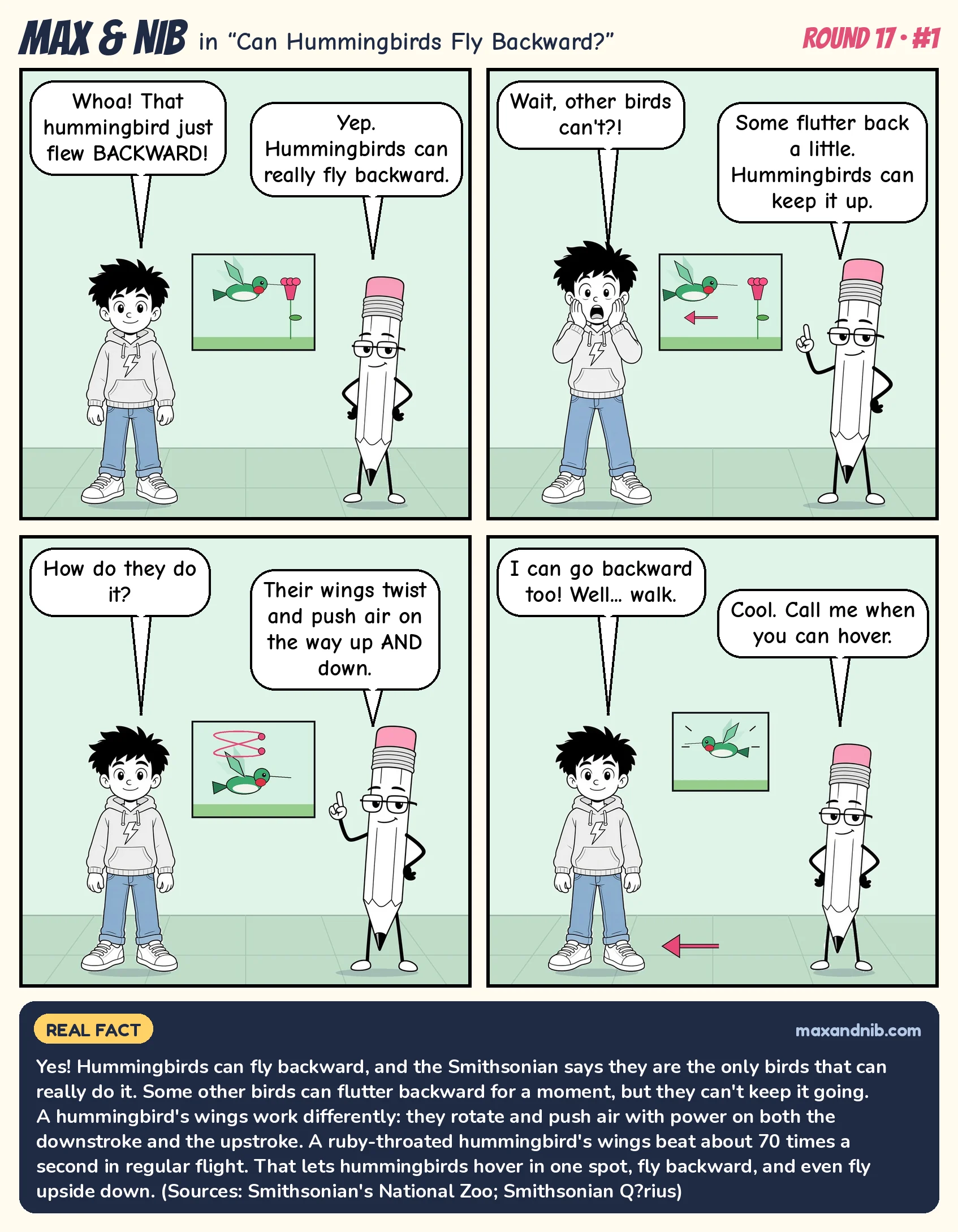
Max, next to a poster of a hummingbird at a red flower, says the hummingbird just flew backward; Nib says hummingbirds really can fly backward. Max is shocked and asks if other birds can't, next to a poster of a hummingbird backing away from a flower with a backward arrow; Nib says some birds flutter back a little but hummingbirds can keep it up. Next to a poster showing the figure-8 path of a hummingbird's wing, Max asks how they do it; Nib says their wings twist and push air on the way up and down. Max, with a backward arrow on the floor, says he can fly backward too, well, walk; Nib says to call him when he can hover.
Comic · Animals

Can Hummingbirds Fly Backward?

Real fact: Yes! Hummingbirds can fly backward, and the Smithsonian says they are the only birds that can really do it. Some other birds can flutter backward for a moment, but they can't keep it going. A hummingbird's wings work differently: they rotate and push air with power on both the downstroke and the upstroke. A ruby-throated hummingbird's wings beat about 70 times a second in regular flight. That lets hummingbirds hover in one spot, fly backward, and even fly upside down. (Sources: Smithsonian's National Zoo; Smithsonian Q?rius)

Where this fact comes from
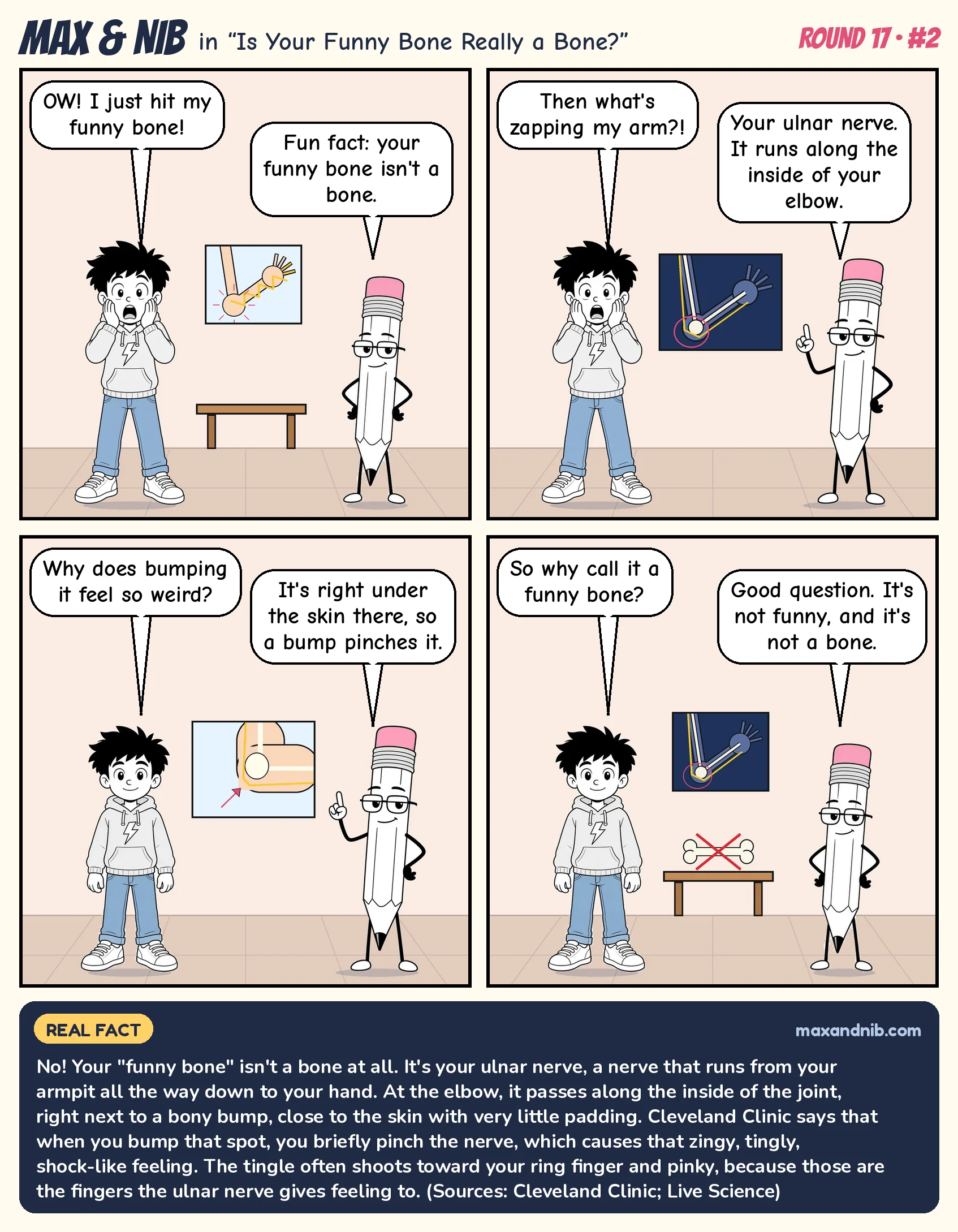
Max, shocked next to a table and a poster of an arm with a zap at the elbow, says he just hit his funny bone; Nib says the funny bone isn't a bone. Next to an x-ray style poster of a bent arm with a yellow nerve circled at the elbow, Max asks what is zapping his arm; Nib says it's the ulnar nerve, which runs along the inside of the elbow. Next to a close-up poster of an elbow with the nerve just under the skin, Max asks why bumping it feels so weird; Nib says it's right under the skin there, so a bump pinches it. Next to a table with a cartoon bone crossed out, Max asks why it's called a funny bone; Nib says good question, it's not funny and it's not a bone.
Comic · Human Body

Is Your Funny Bone Really a Bone?

Real fact: No! Your "funny bone" isn't a bone at all. It's your ulnar nerve, a nerve that runs from your armpit all the way down to your hand. At the elbow, it passes along the inside of the joint, right next to a bony bump, close to the skin with very little padding. Cleveland Clinic says that when you bump that spot, you briefly pinch the nerve, which causes that zingy, tingly, shock-like feeling. The tingle often shoots toward your ring finger and pinky, because those are the fingers the ulnar nerve gives feeling to. (Sources: Cleveland Clinic; Live Science)

Where this fact comes from
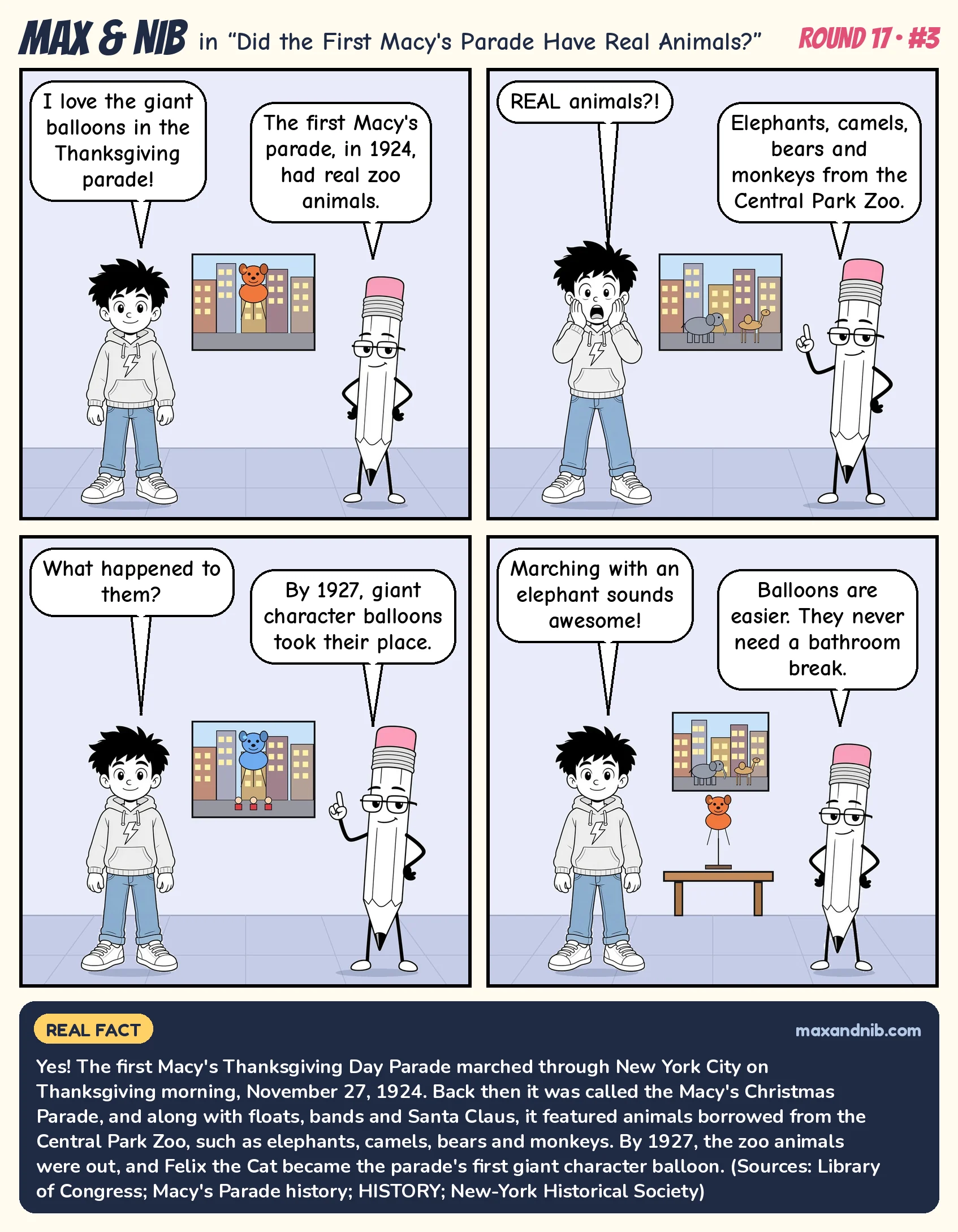
Max, next to a poster of a giant parade balloon over a city street, says he loves the giant balloons in the Thanksgiving parade; Nib says the first Macy's parade, in 1924, had real zoo animals. Max is shocked; next to a poster of an elephant and a camel marching down a city street, Nib says there were elephants, camels, bears and monkeys from the Central Park Zoo. Next to a poster of a giant balloon floating over marchers, Max asks what happened to them; Nib says by 1927 giant character balloons took their place. Next to a table with a little toy parade balloon, Max says marching with an elephant sounds awesome; Nib says balloons are easier, they never need a bathroom break.
Comic · History

Did the First Macy's Parade Have Real Animals?

Real fact: Yes! The first Macy's Thanksgiving Day Parade marched through New York City on Thanksgiving morning, November 27, 1924. Back then it was called the Macy's Christmas Parade, and along with floats, bands and Santa Claus, it featured animals borrowed from the Central Park Zoo, such as elephants, camels, bears and monkeys. By 1927, the zoo animals were out, and Felix the Cat became the parade's first giant character balloon. (Sources: Library of Congress; Macy's Parade history; HISTORY; New-York Historical Society)

Where this fact comes from
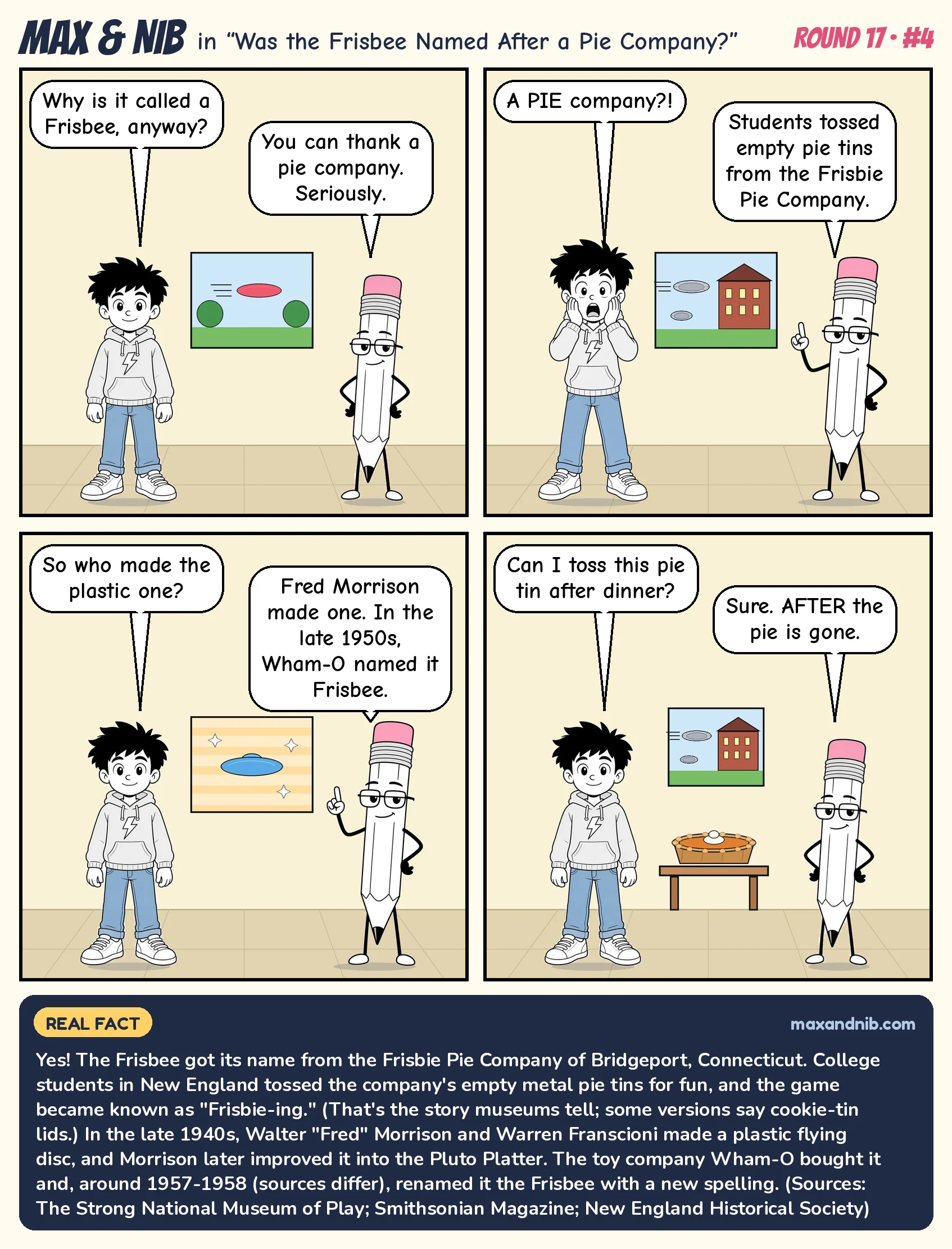
Max, next to a poster of a flying disc over a park, asks why it's called a Frisbee; Nib says you can thank a pie company, seriously. Max is shocked; next to a poster of metal pie tins flying over a college lawn, Nib says students tossed empty pie tins from the Frisbie Pie Company. Next to a poster of a blue plastic flying disc, Max asks who made the plastic one; Nib says Fred Morrison made one, and in the late 1950s Wham-O named it the Frisbee. Next to a table with a pumpkin pie, Max asks if he can toss this pie tin after dinner; Nib says sure, after the pie is gone.
Comic · Inventions

Was the Frisbee Named After a Pie Company?

Real fact: Yes! The Frisbee got its name from the Frisbie Pie Company of Bridgeport, Connecticut. College students in New England tossed the company's empty metal pie tins for fun, and the game became known as "Frisbie-ing." (That's the story museums tell; some versions say cookie-tin lids.) In the late 1940s, Walter "Fred" Morrison and Warren Franscioni made a plastic flying disc, and Morrison later improved it into the Pluto Platter. The toy company Wham-O bought it and, around 1957-1958 (sources differ), renamed it the Frisbee with a new spelling. (Sources: The Strong National Museum of Play; Smithsonian Magazine; New England Historical Society)

Where this fact comes from