Round 18

Heavy Clouds, Tasting Feet & Saturn's Giant Hexagon

Video · 30 sec · all words on screen, works muted

How Much Does a Cloud Weigh?

Real fact: Clouds look light and fluffy, but they are made of water, so they have weight. The U.S. Geological Survey (USGS) works it out for a typical puffy cumulus cloud about 1 kilometer (about 0.6 mile) wide, tall and deep: it holds about 1.1 million pounds (about 500,000 kilograms) of water droplets. A scientist at the National Center for Atmospheric Research compares that to about 100 elephants. The cloud doesn't fall because its water is spread out into trillions of super-tiny droplets, the moist cloud air is a little lighter than the dry air around it, and rising warm air helps hold it up. Every cloud is different, so this is an estimate.
Where this fact comes from
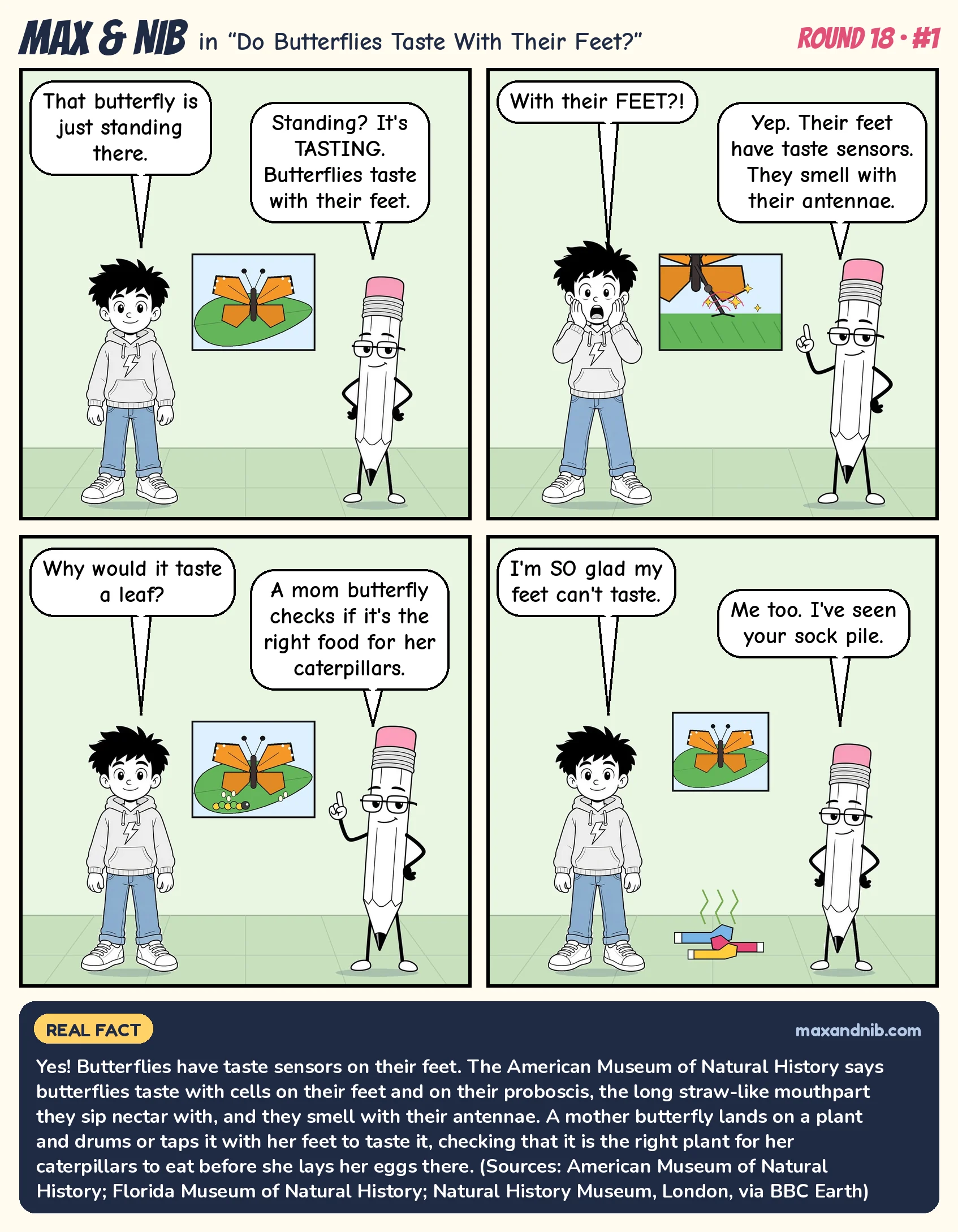
Max, next to a poster of an orange butterfly standing on a big green leaf, says the butterfly is just standing there; Nib says it's tasting, because butterflies taste with their feet. Max is shocked; next to a close-up poster of a butterfly's leg touching a leaf with little sparkles, Nib says their feet have taste sensors and they smell with their antennae. Next to a poster of a butterfly on a leaf with tiny eggs and a caterpillar, Max asks why a butterfly would taste a leaf; Nib says a mother butterfly checks if it's the right food for her caterpillars. Max, next to a pile of smelly socks on the floor, says he's glad his feet can't taste; Nib says him too, he's seen that sock pile.
Comic · Animals

Do Butterflies Taste With Their Feet?

Real fact: Yes! Butterflies have taste sensors on their feet. The American Museum of Natural History says butterflies taste with cells on their feet and on their proboscis, the long straw-like mouthpart they sip nectar with, and they smell with their antennae. A mother butterfly lands on a plant and drums or taps it with her feet to taste it, checking that it is the right plant for her caterpillars to eat before she lays her eggs there. (Sources: American Museum of Natural History; Florida Museum of Natural History; Natural History Museum, London, via BBC Earth)

Where this fact comes from
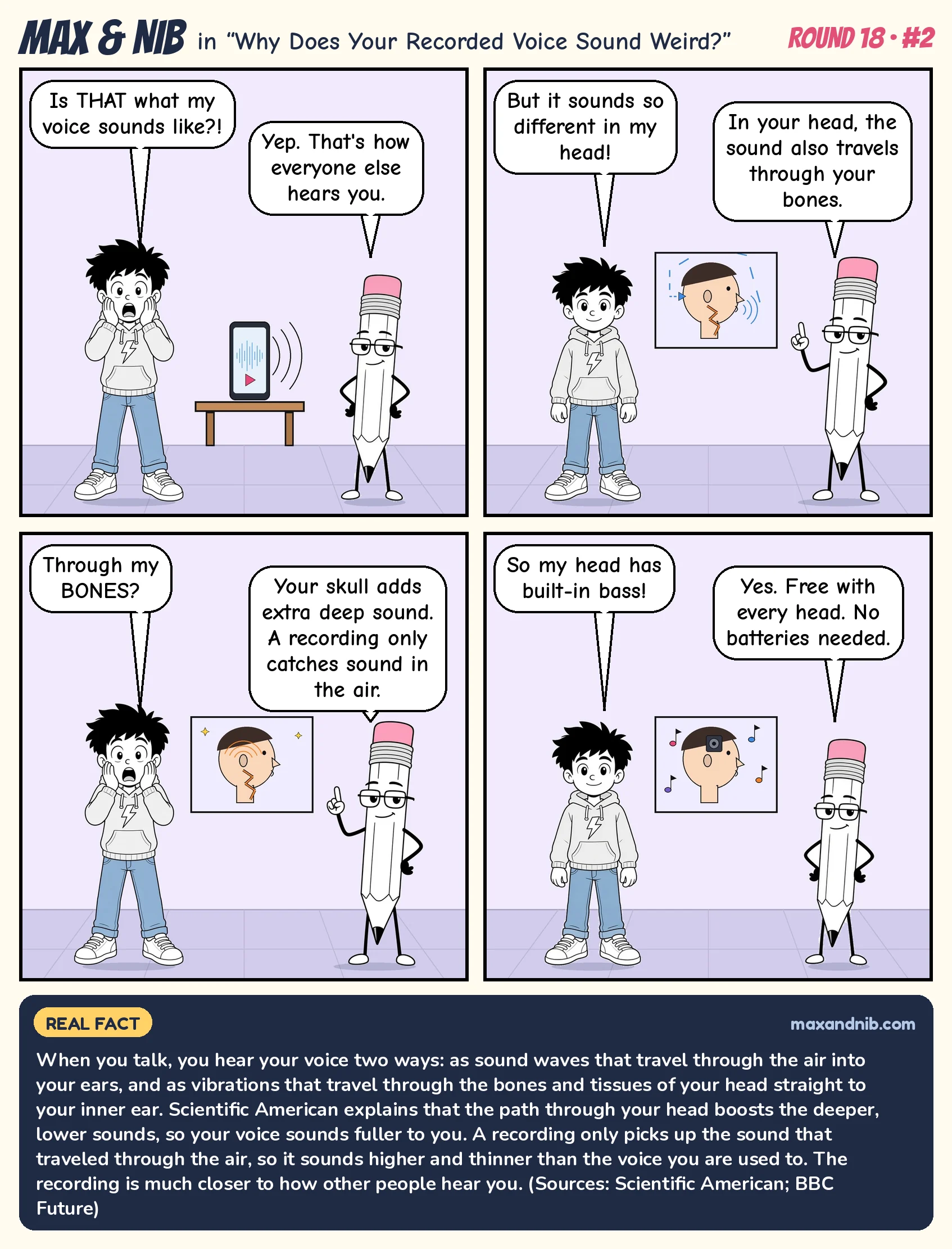
Max, shocked, next to a phone on a table playing back a voice recording, asks if that's really what his voice sounds like; Nib says yes, that's how everyone else hears him. Next to a poster of a head with sound waves going out of the mouth and around to the ear, plus an orange zig-zag inside the head, Max says it sounds so different in his head; Nib says in his head, the sound also travels through his bones. Max is shocked next to a poster of the orange zig-zag glowing inside the head; Nib says his skull adds extra deep sound, and a recording only catches the sound in the air. Next to a poster of a head with music notes and a tiny speaker, Max says his head has built-in bass; Nib says it comes free with every head and needs no batteries.
Comic · Human Body

Why Does Your Recorded Voice Sound Weird?

Real fact: When you talk, you hear your voice two ways: as sound waves that travel through the air into your ears, and as vibrations that travel through the bones and tissues of your head straight to your inner ear. Scientific American explains that the path through your head boosts the deeper, lower sounds, so your voice sounds fuller to you. A recording only picks up the sound that traveled through the air, so it sounds higher and thinner than the voice you are used to. The recording is much closer to how other people hear you. (Sources: Scientific American; BBC Future)

Where this fact comes from
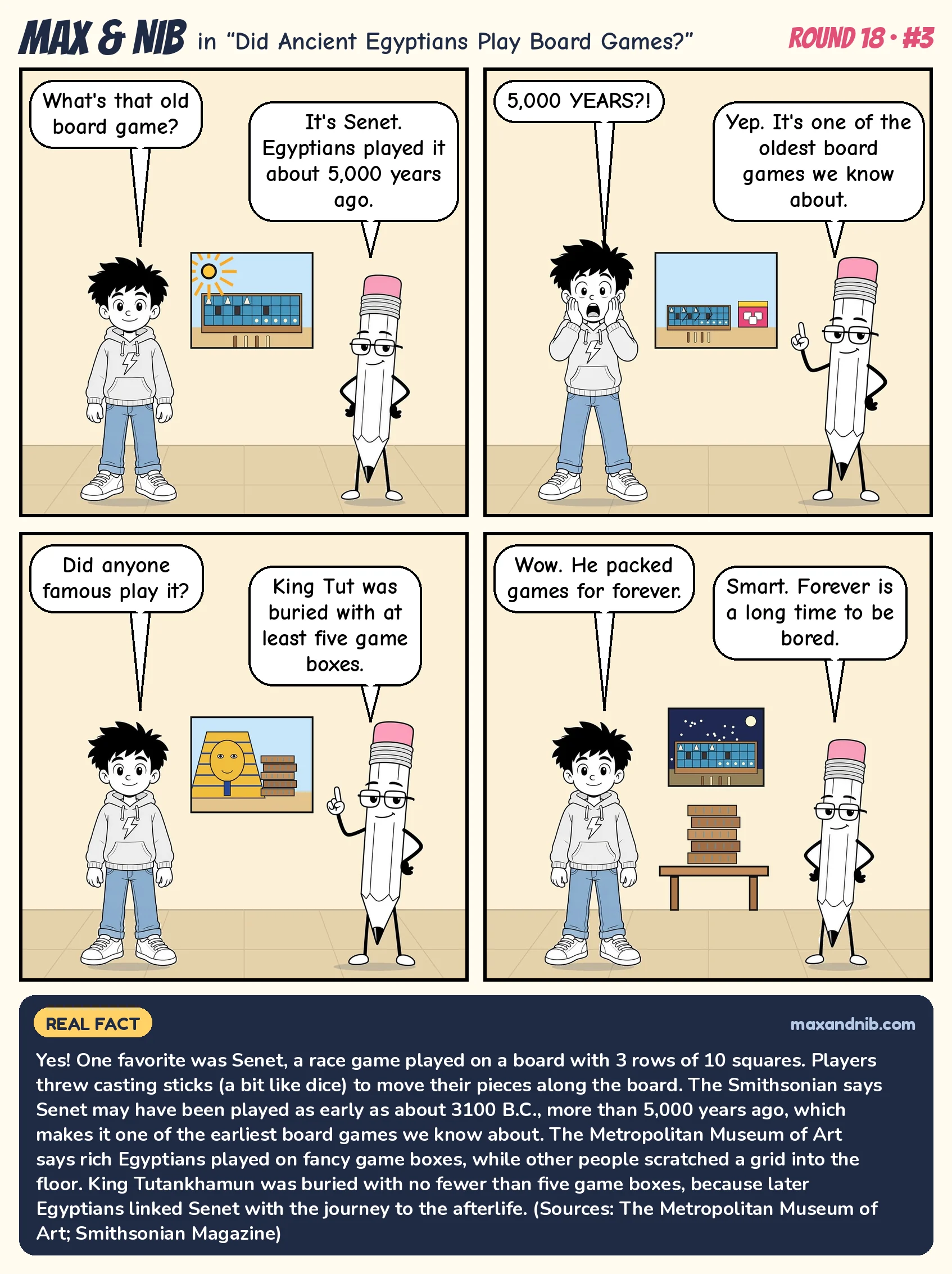
Max, next to a poster of a blue board with three rows of ten squares and game pieces in the desert sun, asks what that old board game is; Nib says it's Senet, which Egyptians played about 5,000 years ago. Max is shocked next to a poster of a cracked old Senet board beside a modern game box; Nib says it's one of the oldest board games we know about. Next to a poster of a friendly golden headdress figure and a stack of five game boxes, Max asks if anyone famous played it; Nib says King Tut was buried with at least five game boxes. Max, next to a stack of game boxes on a table and a poster of a Senet board under the stars, says Tut packed games for forever; Nib says smart, forever is a long time to be bored.
Comic · History

Did Ancient Egyptians Play Board Games?

Real fact: Yes! One favorite was Senet, a race game played on a board with 3 rows of 10 squares. Players threw casting sticks (a bit like dice) to move their pieces along the board. The Smithsonian says Senet may have been played as early as about 3100 B.C., more than 5,000 years ago, which makes it one of the earliest board games we know about. The Metropolitan Museum of Art says rich Egyptians played on fancy game boxes, while other people scratched a grid into the floor. King Tutankhamun was buried with no fewer than five game boxes, because later Egyptians linked Senet with the journey to the afterlife. (Sources: The Metropolitan Museum of Art; Smithsonian Magazine)

Where this fact comes from
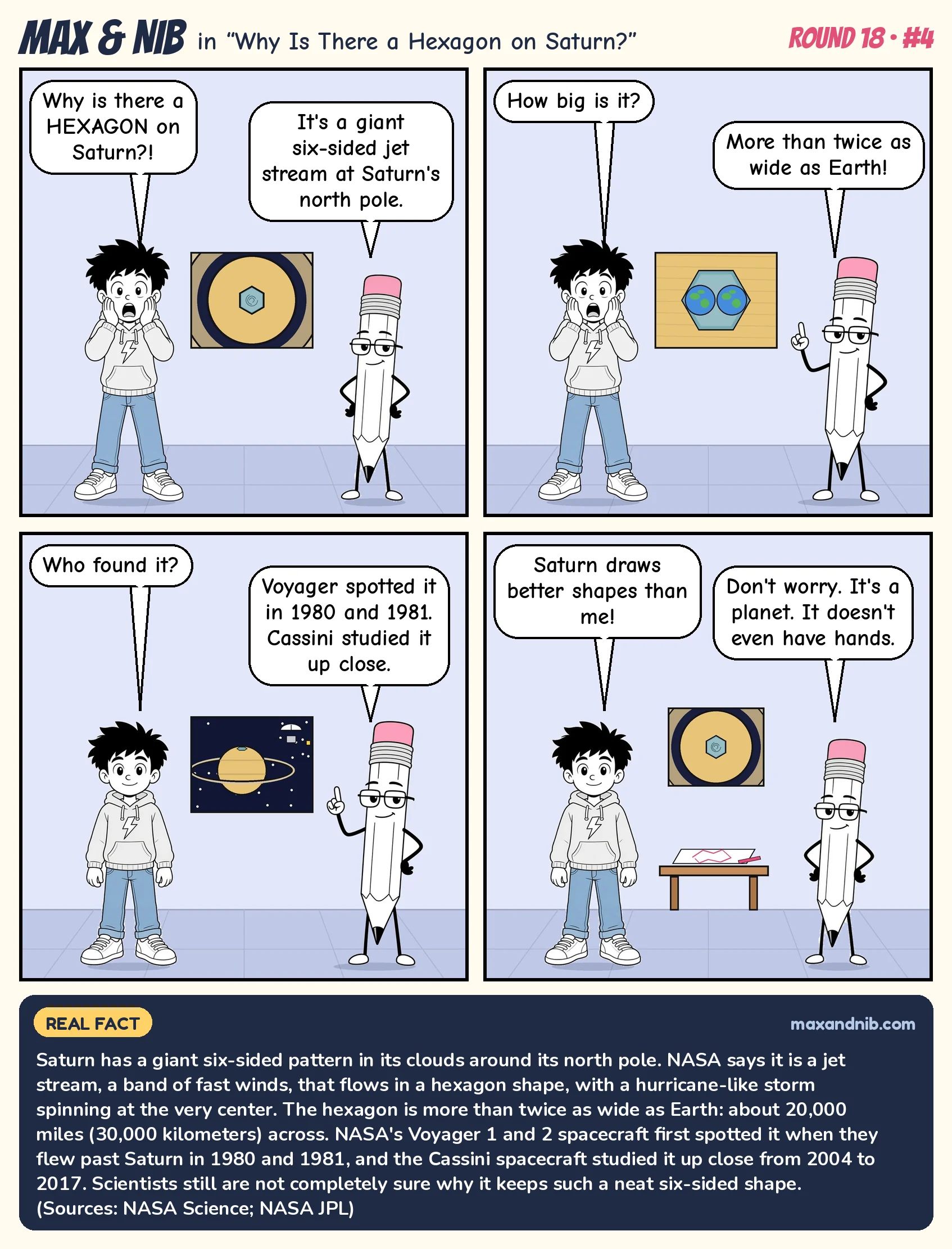
Max, shocked, next to a poster looking down on Saturn's north pole with a six-sided shape in the middle, asks why there's a hexagon on Saturn; Nib says it's a giant six-sided jet stream at Saturn's north pole. Max is shocked next to a close-up poster of the hexagon with two Earths side by side inside it; Nib says it's more than twice as wide as Earth. Next to a poster of Saturn and its rings with a small space probe flying by, Max asks who found it; Nib says the Voyager probes spotted it in 1980 and 1981 and Cassini studied it up close. Max, next to a paper on a table with a wobbly crayon hexagon, says Saturn draws better shapes than he does; Nib tells him not to worry, it's a planet and doesn't even have hands.
Comic · Space

Why Is There a Hexagon on Saturn?

Real fact: Saturn has a giant six-sided pattern in its clouds around its north pole. NASA says it is a jet stream, a band of fast winds, that flows in a hexagon shape, with a hurricane-like storm spinning at the very center. The hexagon is more than twice as wide as Earth: about 20,000 miles (30,000 kilometers) across. NASA's Voyager 1 and 2 spacecraft first spotted it when they flew past Saturn in 1980 and 1981, and the Cassini spacecraft studied it up close from 2004 to 2017. Scientists still are not completely sure why it keeps such a neat six-sided shape. (Sources: NASA Science; NASA JPL)

Where this fact comes from