Round 19

The Deepest Hole, Fly-Confusing Stripes & a Days-Long Photo

Video · 30 sec · all words on screen, works muted

What's the Deepest Hole Ever Dug?

Real fact: The deepest hole people have ever dug is the Kola Superdeep Borehole in northwest Russia. Soviet scientists started drilling it in 1970 to study Earth's crust. After almost 20 years, in 1989, it reached 40,230 feet (12,262 meters), about 7.6 miles straight down. But the hole is only about 9 inches (23 centimeters) wide, so no one could ever climb down it. Deep down, the rock was about 356°F (180°C), much hotter than scientists expected, and the heat damaged the drilling equipment, so drilling stopped in 1992. Even so, it got less than 1% of the way to Earth's center, which is about 4,000 miles (6,371 kilometers) down. Some oil wells are longer, but they bend and run sideways; Kola is still the deepest straight down. (Sources: Smithsonian Magazine; Scientific American; NASA)

Where this fact comes from
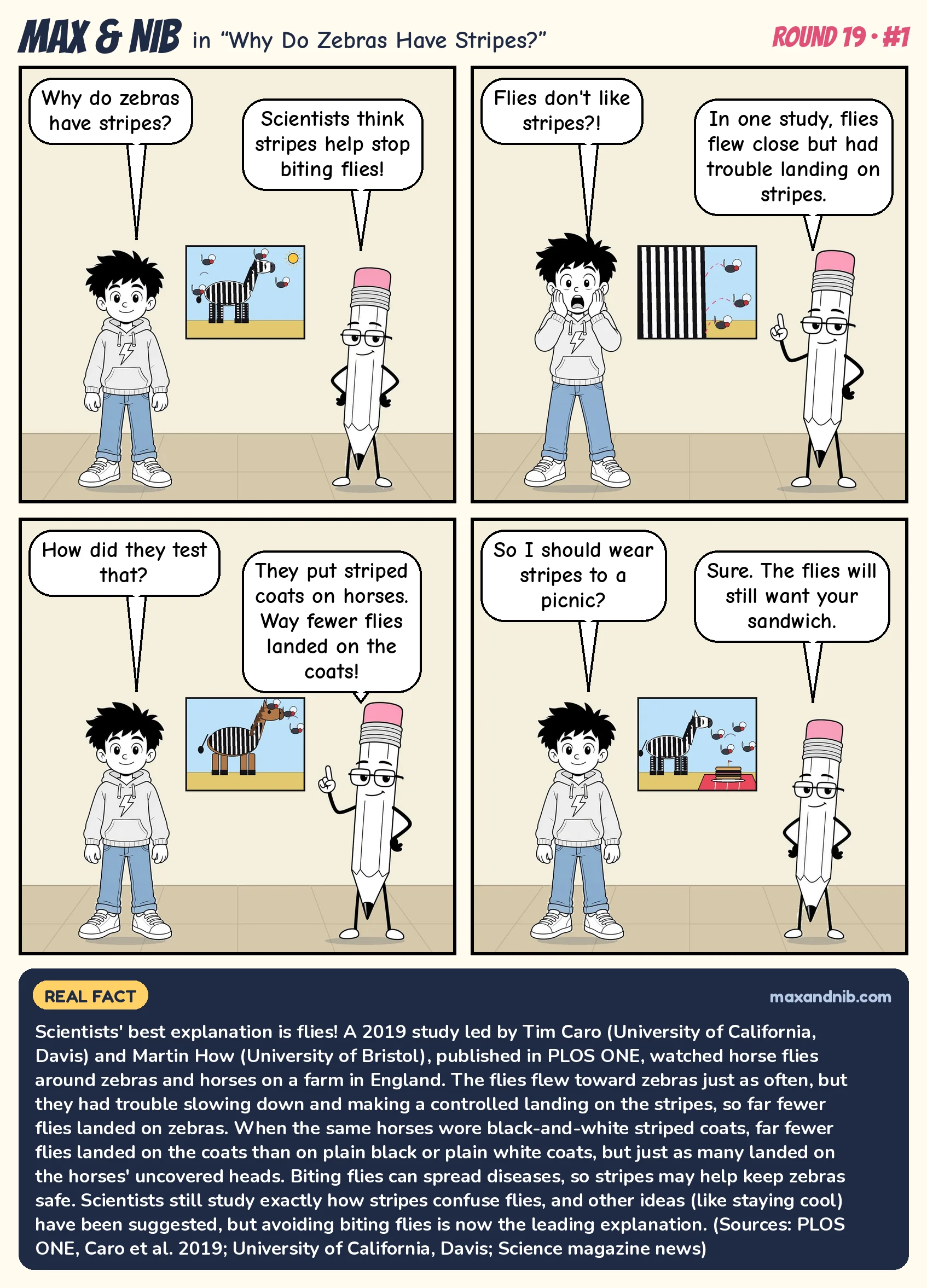
Max, next to a poster of a zebra on a sunny savanna with little flies buzzing around it, asks why zebras have stripes; Nib says scientists think stripes help stop biting flies. Max is shocked; next to a close-up poster of black-and-white stripes with flies bouncing away, Nib says in one study flies flew close but had trouble landing on stripes. Next to a poster of a brown horse wearing a striped coat with flies only near its head, Max asks how they tested it; Nib says scientists put striped coats on horses and far fewer flies landed on the coats. Max, next to a poster of a zebra beside a picnic blanket with a sandwich and flies circling it, asks if he should wear stripes to a picnic; Nib says sure, but the flies will still want his sandwich.
Comic · Animals

Why Do Zebras Have Stripes?

Real fact: Scientists' best explanation is flies! A 2019 study led by Tim Caro (University of California, Davis) and Martin How (University of Bristol), published in PLOS ONE, watched horse flies around zebras and horses on a farm in England. The flies flew toward zebras just as often, but they had trouble slowing down and making a controlled landing on the stripes, so far fewer flies landed on zebras. When the same horses wore black-and-white striped coats, far fewer flies landed on the coats than on plain black or plain white coats, but just as many landed on the horses' uncovered heads. Biting flies can spread diseases, so stripes may help keep zebras safe. Scientists still study exactly how stripes confuse flies, and other ideas (like staying cool) have been suggested, but avoiding biting flies is now the leading explanation. (Sources: PLOS ONE, Caro et al. 2019; University of California, Davis; Science magazine news)

Where this fact comes from
Max, next to a poster of a big open mouth with a pink tongue, says his tongue is the strongest muscle in his body; Nib says that's a myth, and the tongue isn't even one muscle. Max is shocked; next to a poster of a tongue painted in eight colorful strands, Nib says the tongue is made of eight muscles working together. Next to a poster of a head from the side with a glowing red jaw muscle biting an apple, Max asks which muscle is strongest; Nib says it depends how you measure, but for its weight the jaw muscle wins. Max, next to a poster of a head talking with sound waves and music notes, says at least his tongue never gets tired; Nib says trust me, he's noticed.
Comic · Human Body

Is the Tongue the Strongest Muscle?

Real fact: No! "The tongue is the strongest muscle" is a myth. Your tongue isn't even one muscle: it's a team of eight muscles that weave together, a bit like an elephant's trunk or an octopus arm. Scientists say there is no single "strongest muscle," because strength can be measured in different ways. The Library of Congress says the strongest muscle based on its weight is the masseter, the main chewing muscle in your jaw: with the other jaw muscles, it can close your back teeth with a force of up to about 200 pounds. What the tongue is great at is stamina: it works all day, helping you talk, chew and swallow, and it rarely gets tired. (Sources: Library of Congress, Everyday Mysteries; Scientific American)

Where this fact comes from
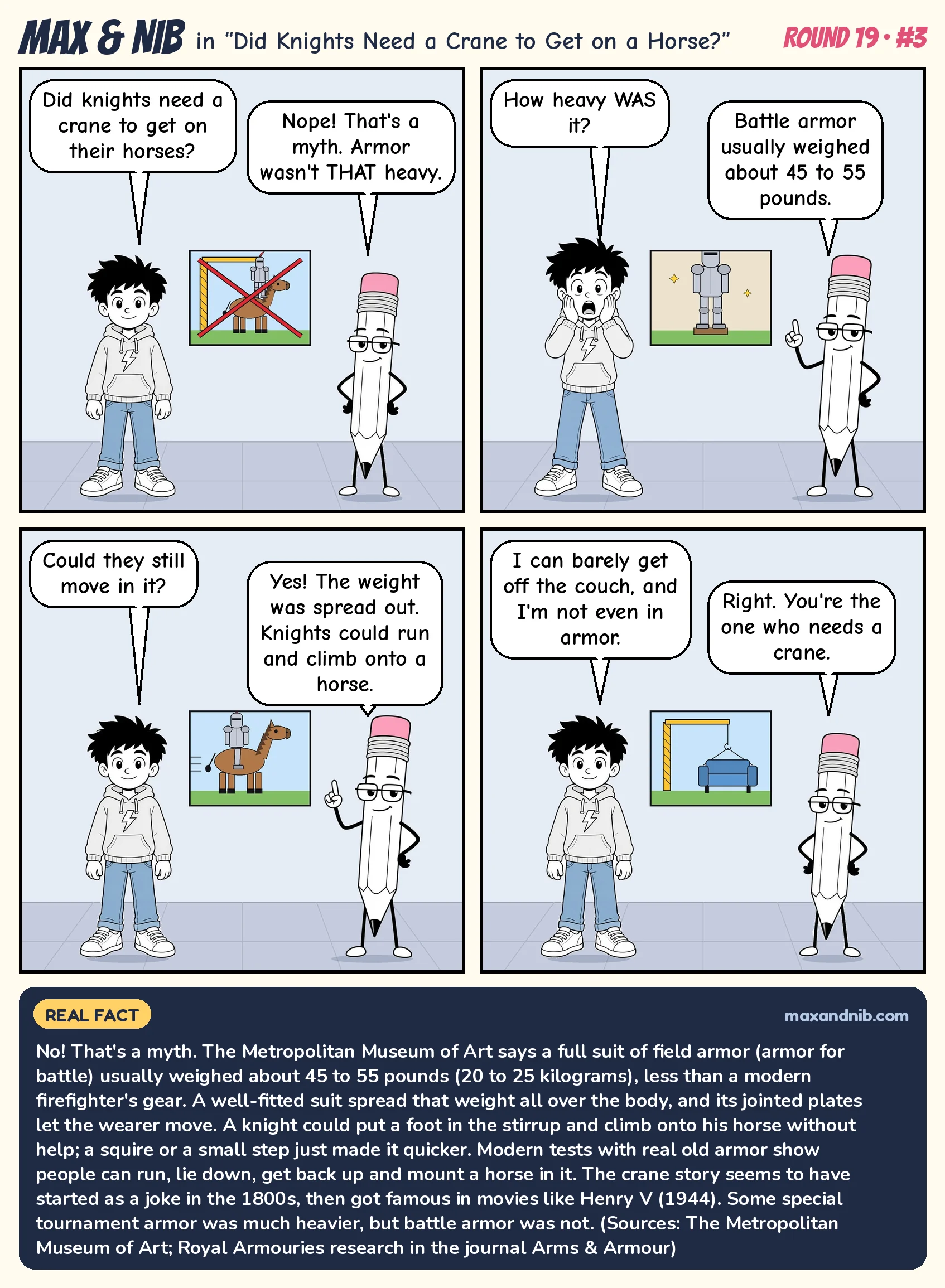
Max, next to a poster of a crane dangling a knight over a horse with a big red X over it, asks if knights needed a crane to climb onto their horses; Nib says nope, that's a myth, and armor wasn't that heavy. Max is shocked; next to a poster of a suit of armor on a stand, Max asks how heavy it was; Nib says battle armor usually weighed about 45 to 55 pounds. Next to a poster of a knight riding a horse, Max asks if they could still move; Nib says yes, the weight was spread all over the body, so knights could run and climb onto a horse. Max, next to a poster of a crane lifting a couch, says he can barely get off the couch and he's not even wearing armor; Nib says right, he's the one who needs a crane.
Comic · History

Did Knights Need a Crane to Get on a Horse?

Real fact: No! That's a myth. The Metropolitan Museum of Art says a full suit of field armor (armor for battle) usually weighed about 45 to 55 pounds (20 to 25 kilograms), less than a modern firefighter's gear. A well-fitted suit spread that weight all over the body, and its jointed plates let the wearer move. A knight could put a foot in the stirrup and climb onto his horse without help; a squire or a small step just made it quicker. Modern tests with real old armor show people can run, lie down, get back up and mount a horse in it. The crane story seems to have started as a joke in the 1800s, then got famous in movies like Henry V (1944). Some special tournament armor was much heavier, but battle armor was not. (Sources: The Metropolitan Museum of Art; Royal Armouries research in the journal Arms & Armour)

Where this fact comes from
Max, next to a poster of an old wooden box camera pointed out a window at rooftops and a tree, asks how long the first photo took to make; Nib says hours, maybe even days. Max is shocked; next to a poster of the same camera with a sun, a moon and another sun showing days passing, Max asks if it was really days for one picture; Nib says yes, around 1827 a French inventor pointed his camera out a window and waited. Next to a poster of a blurry brownish photo of rooftops and a tree in a gold museum frame, Max asks what it shows; Nib says rooftops and a tree, and it's the oldest surviving photo taken with a camera. Max, next to the camera with a little wedge of cheese on the table, says imagine saying cheese for days; Nib says his smile would need a nap.
Comic · Inventions

How Long Did the First Photo Take?

Real fact: A really long time! Around 1826 to 1827, French inventor Joseph Nicéphore Niépce coated a metal (pewter) plate with a light-sensitive asphalt called bitumen of Judea, put it in a camera at an upstairs window of his house in France, and let light shine in. Historians used to say the exposure took at least eight hours. Newer research suggests it took several days, and the Harry Ransom Center at the University of Texas at Austin, which owns the picture today, now says "several days." The photo, View from the Window at Le Gras, shows blurry rooftops, buildings and a tree. It is the oldest surviving photograph made with a camera, which is why it's often called the first photo. Today a phone camera takes a picture in a tiny fraction of a second. (Sources: Harry Ransom Center, University of Texas at Austin; Smarthistory)

Where this fact comes from