Round 8

The Small Intestine Mystery, Koala Fingerprints & Glass Rain

Video · 30 sec · all words on screen, works muted

Why Is the Small Intestine Called Small?

Real fact: The small intestine is called “small” because it's skinny, not because it's short. It's only about 1 inch (2.5 cm) wide, while the large intestine is about 3 inches (7.6 cm) wide. But stretched out, an adult's small intestine is about 20 feet (6 meters) long, and the large intestine is only about 5 feet (1.5 meters). So the “small” one is the longest part of your whole digestive tube! (Lengths vary from person to person. Inside a living body, the small intestine is squeezed shorter by its muscles, about 10 feet, but it's still much longer than the large intestine.)
Where this fact comes from
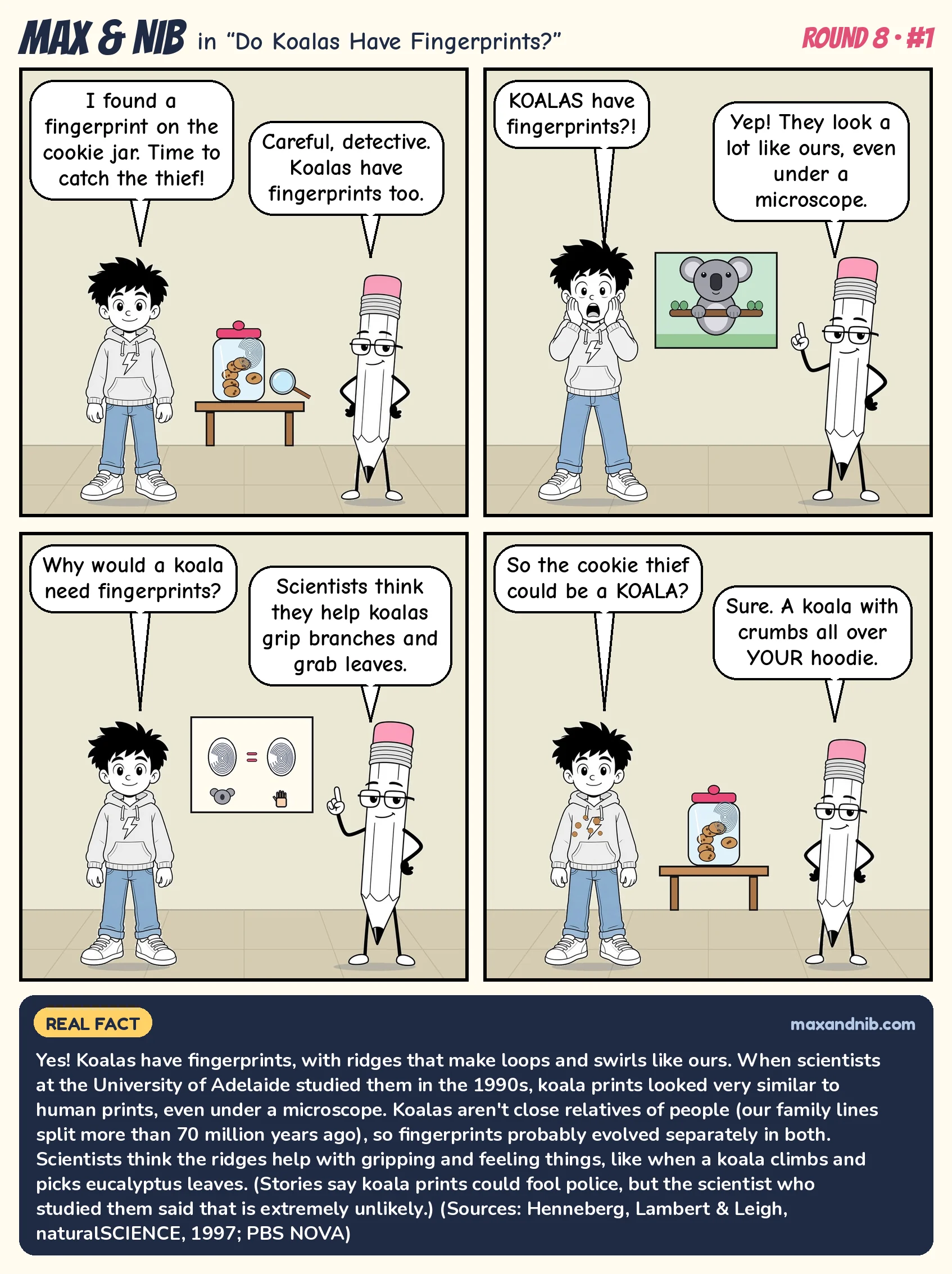
Max holds up a cookie jar with a fingerprint on it and says it's time to catch the thief; Nib warns that koalas have fingerprints too. Max is shocked; Nib points to a koala poster and says koala prints look a lot like ours, even under a microscope. Max asks why a koala would need fingerprints; Nib points to a chart showing a koala print and a human print side by side and says scientists think they help koalas grip branches and grab leaves. Max asks if the cookie thief could be a koala; Nib notes the cookie crumbs all over Max's own hoodie.
Comic · Animals

Do Koalas Have Fingerprints?

Real fact: Yes! Koalas have fingerprints, with ridges that make loops and swirls like ours. When scientists at the University of Adelaide studied them in the 1990s, koala prints looked very similar to human prints, even under a microscope. Koalas aren't close relatives of people (our family lines split more than 70 million years ago), so fingerprints probably evolved separately in both. Scientists think the ridges help with gripping and feeling things, like when a koala climbs and picks eucalyptus leaves. (Stories say koala prints could fool police, but the scientist who studied them said that is extremely unlikely.) (Sources: Henneberg, Lambert & Leigh, naturalSCIENCE, 1997; PBS NOVA)

Where this fact comes from
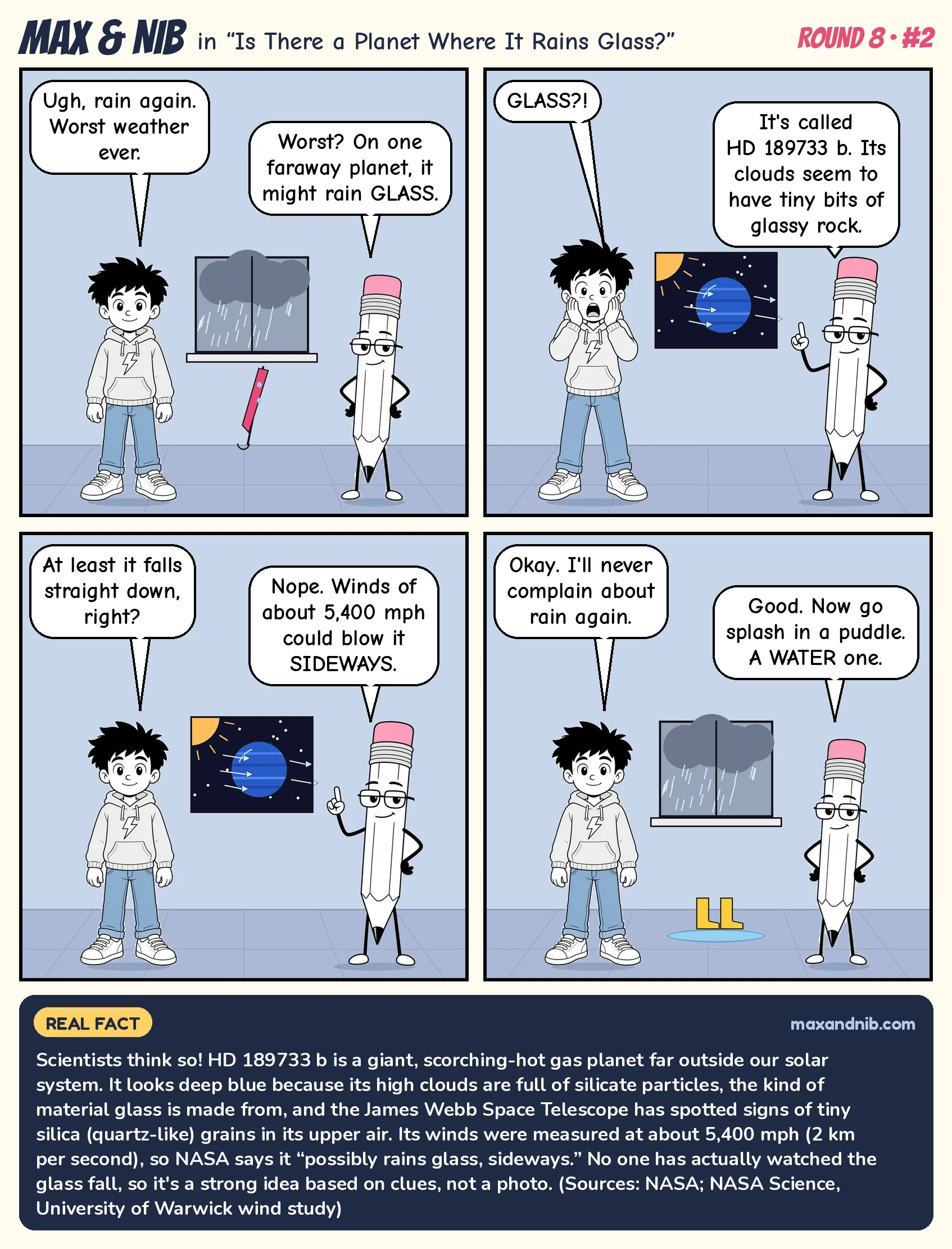
Max looks at the rain outside and calls it the worst weather ever; Nib says that on one faraway planet it might rain glass. Max is shocked; Nib points to a space poster of a deep-blue planet and says it's called HD 189733 b and its clouds seem to have tiny bits of glassy rock. Max asks if at least the rain falls straight down; Nib says no, winds of about 5,400 miles per hour could blow it sideways. Max promises never to complain about rain again; next to a puddle and rain boots, Nib tells him to go splash in a puddle, a water one.
Comic · Space

Is There a Planet Where It Rains Glass?

Real fact: Scientists think so! HD 189733 b is a giant, scorching-hot gas planet far outside our solar system. It looks deep blue because its high clouds are full of silicate particles, the kind of material glass is made from, and the James Webb Space Telescope has spotted signs of tiny silica (quartz-like) grains in its upper air. Its winds were measured at about 5,400 mph (2 km per second), so NASA says it “possibly rains glass, sideways.” No one has actually watched the glass fall, so it's a strong idea based on clues, not a photo. (Sources: NASA; NASA Science, University of Warwick wind study)

Where this fact comes from
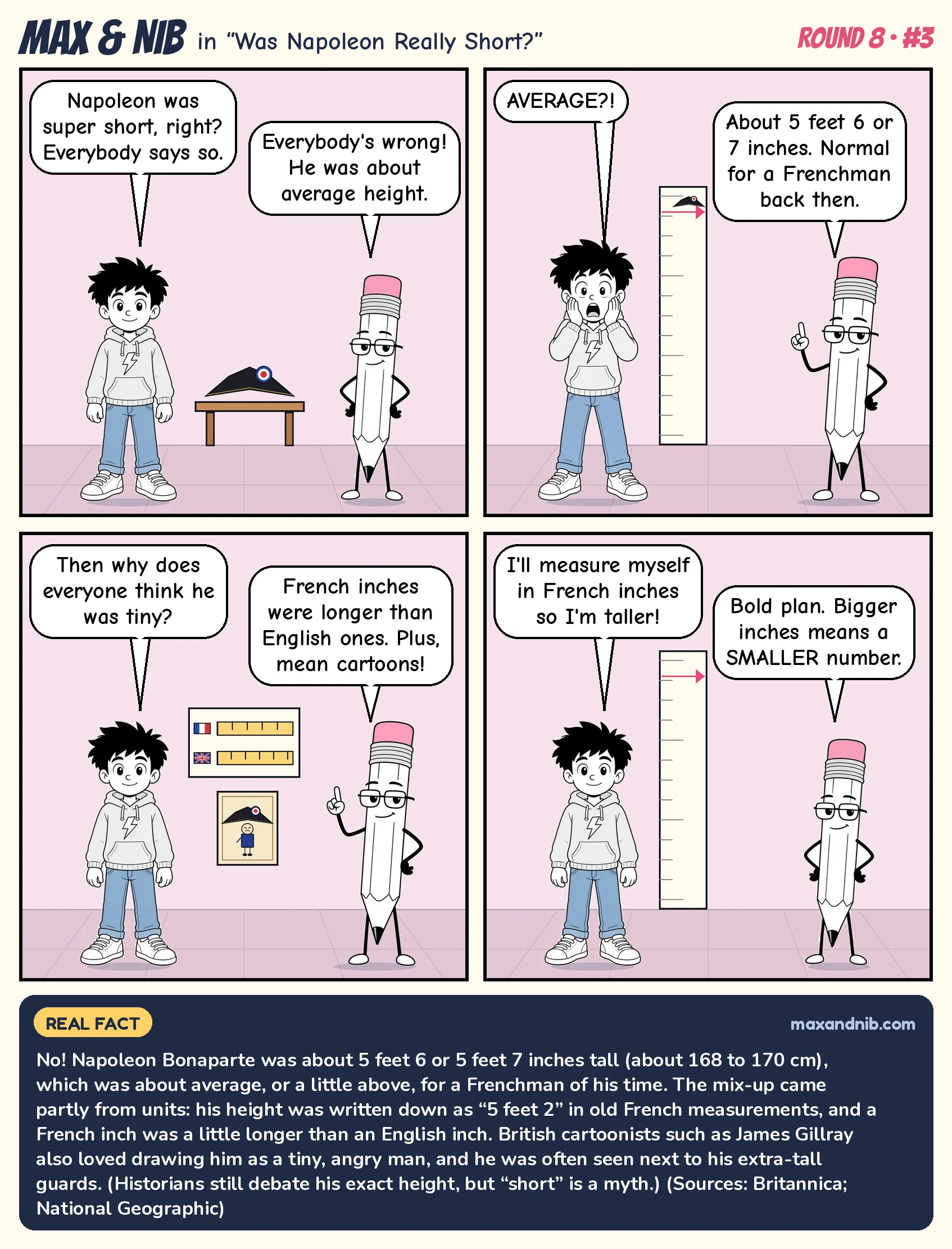
Max, next to a black two-cornered hat on a table, says Napoleon was super short because everybody says so; Nib says everybody's wrong and he was about average height. Max is shocked; Nib points to a height chart and says he was about 5 feet 6 or 7 inches, normal for a Frenchman back then. Max asks why everyone thinks he was tiny; Nib points to a chart of a French ruler and an English ruler and an old cartoon of a tiny man in a giant hat, and says French inches were longer than English ones, plus mean cartoons. Max says he'll measure himself in French inches so he's taller; Nib says bold plan, but bigger inches means a smaller number.
Comic · History

Was Napoleon Really Short?

Real fact: No! Napoleon Bonaparte was about 5 feet 6 or 5 feet 7 inches tall (about 168 to 170 cm), which was about average, or a little above, for a Frenchman of his time. The mix-up came partly from units: his height was written down as “5 feet 2” in old French measurements, and a French inch was a little longer than an English inch. British cartoonists such as James Gillray also loved drawing him as a tiny, angry man, and he was often seen next to his extra-tall guards. (Historians still debate his exact height, but “short” is a myth.) (Sources: Britannica; National Geographic)

Where this fact comes from
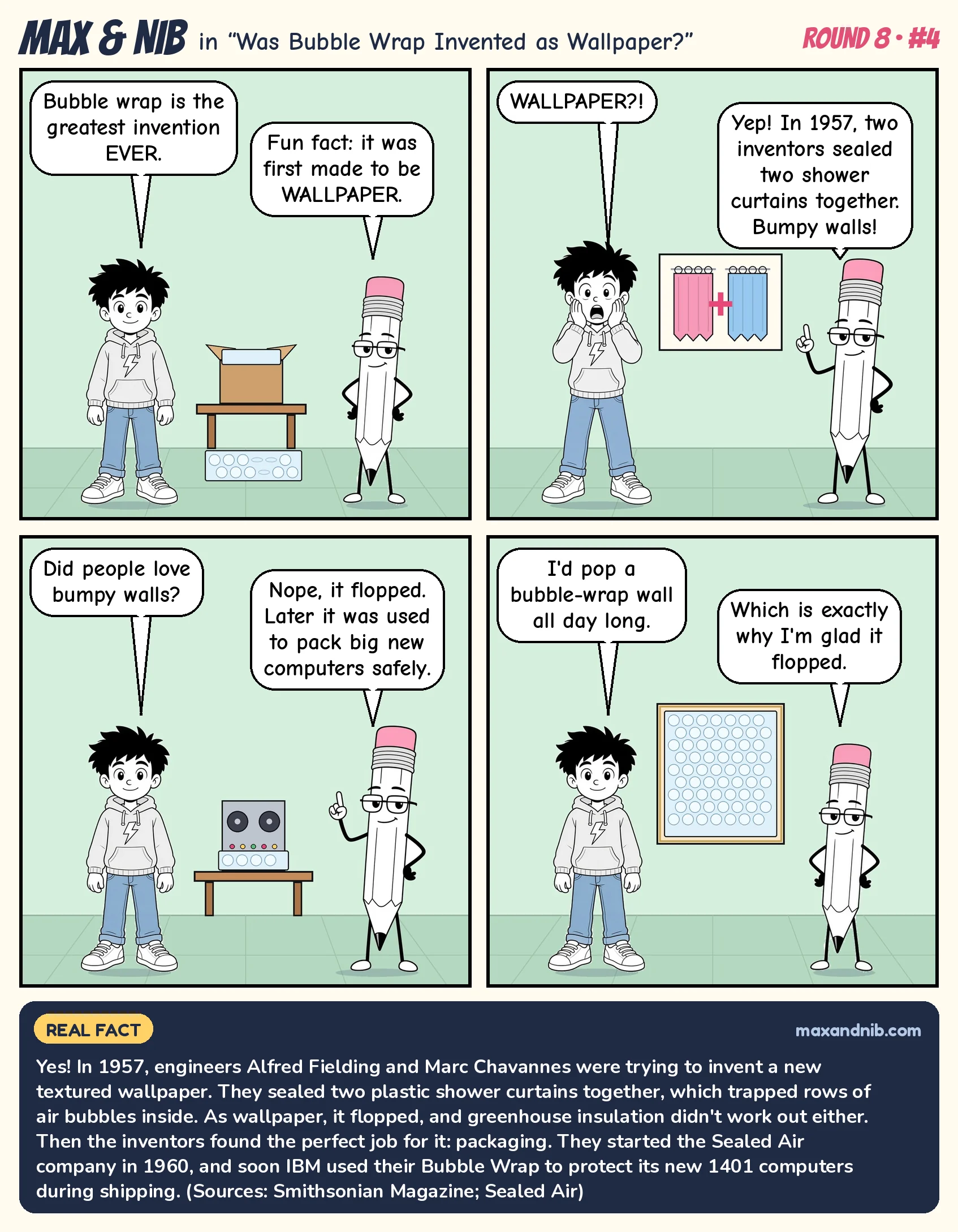
Max, next to a box of bubble wrap, says bubble wrap is the greatest invention ever; Nib says it was first made to be wallpaper. Max is shocked; Nib points to a picture of two shower curtains and says that in 1957 two inventors sealed two shower curtains together to make bumpy walls. Max asks if people loved bumpy walls; next to an old computer wrapped in bubble wrap, Nib says no, it flopped, and later it was used to pack big new computers safely. In front of a framed bubble-wrap wall panel, Max says he'd pop a bubble-wrap wall all day long; Nib says that's exactly why he's glad it flopped.
Comic · Tech & Inventions

Was Bubble Wrap Invented as Wallpaper?

Real fact: Yes! In 1957, engineers Alfred Fielding and Marc Chavannes were trying to invent a new textured wallpaper. They sealed two plastic shower curtains together, which trapped rows of air bubbles inside. As wallpaper, it flopped, and greenhouse insulation didn't work out either. Then the inventors found the perfect job for it: packaging. They started the Sealed Air company in 1960, and soon IBM used their Bubble Wrap to protect its new 1401 computers during shipping. (Sources: Smithsonian Magazine; Sealed Air)

Where this fact comes from