Round 9

Pluto vs. the Moon, Half-Asleep Dolphins & Upside-Down Eyes

Video · 30 sec · all words on screen, works muted

Is Pluto Smaller Than Our Moon?

Real fact: Yes! Pluto is smaller than Earth's Moon. NASA says the Moon is about 2,159 miles (3,475 km) wide, and Pluto is only about 1,477 miles (2,377 km) wide. That makes Pluto about two-thirds as wide as our Moon. Pluto was called the ninth planet for 76 years, until scientists reclassified it as a dwarf planet in 2006. NASA's New Horizons spacecraft measured Pluto up close when it flew past in 2015. (Widths are measured across the middle, from edge to edge, and are rounded.)
Where this fact comes from
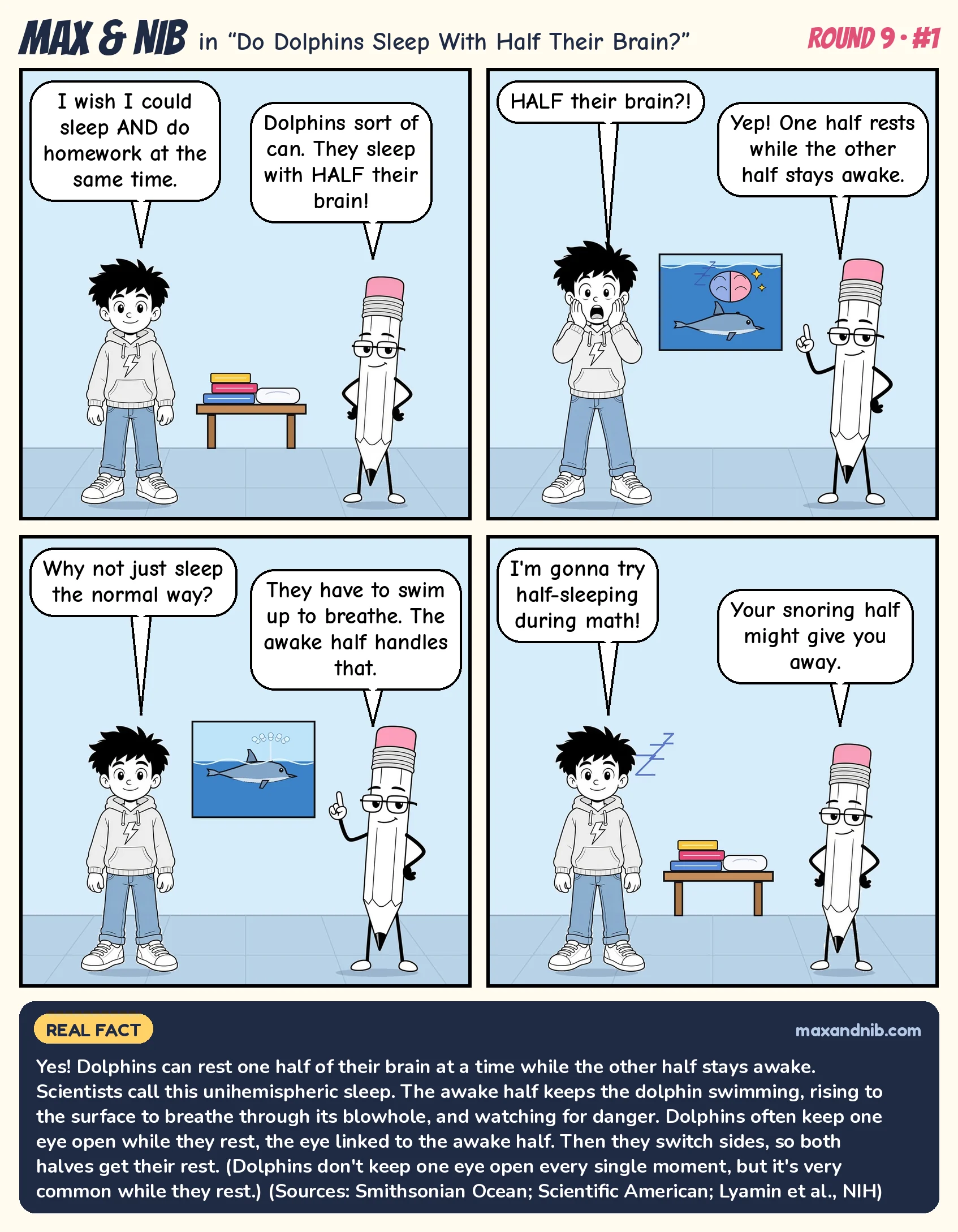
Max, next to a table with homework books and a pillow, wishes he could sleep and do homework at the same time; Nib says dolphins sort of can, because they sleep with half their brain. Max is shocked; Nib points to a poster of a resting dolphin with a brain icon that is half sleepy and half awake, and says one half rests while the other half stays awake. Max asks why they don't just sleep the normal way; Nib points to a poster of a dolphin blowing a spout at the surface and says they have to swim up to breathe, and the awake half handles that. Max says he'll try half-sleeping during math; little sleepy Zs float by as Nib says his snoring half might give him away.
Comic · Animals

Do Dolphins Sleep With Half Their Brain?

Real fact: Yes! Dolphins can rest one half of their brain at a time while the other half stays awake. Scientists call this unihemispheric sleep. The awake half keeps the dolphin swimming, rising to the surface to breathe through its blowhole, and watching for danger. Dolphins often keep one eye open while they rest, the eye linked to the awake half. Then they switch sides, so both halves get their rest. (Dolphins don't keep one eye open every single moment, but it's very common while they rest.) (Sources: Smithsonian Ocean; Scientific American; Lyamin et al., NIH)

Where this fact comes from
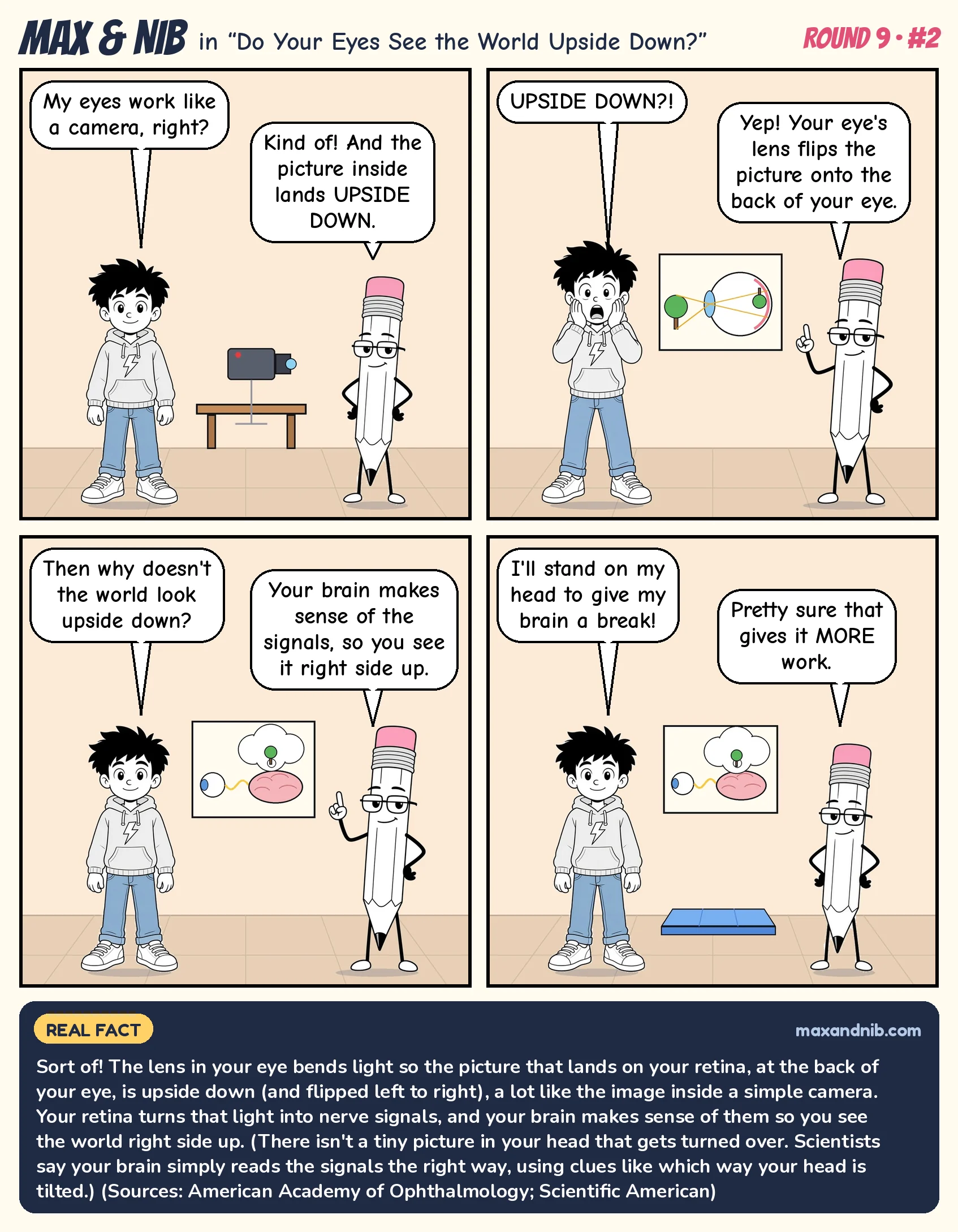
Max, next to a camera on a table, asks if his eyes work like a camera; Nib says kind of, and the picture inside lands upside down. Max is shocked; Nib points to a chart where light rays from a tree cross through the eye's lens and make an upside-down tree on the back of the eye. Max asks why the world doesn't look upside down; Nib points to a chart of an eye connected to a brain that pictures the tree right side up, and says the brain makes sense of the signals. Next to an exercise mat, Max says he'll stand on his head to give his brain a break; Nib says that probably gives it more work.
Comic · Human Body

Do Your Eyes See the World Upside Down?

Real fact: Sort of! The lens in your eye bends light so the picture that lands on your retina, at the back of your eye, is upside down (and flipped left to right), a lot like the image inside a simple camera. Your retina turns that light into nerve signals, and your brain makes sense of them so you see the world right side up. (There isn't a tiny picture in your head that gets turned over. Scientists say your brain simply reads the signals the right way, using clues like which way your head is tilted.) (Sources: American Academy of Ophthalmology; Scientific American)

Where this fact comes from
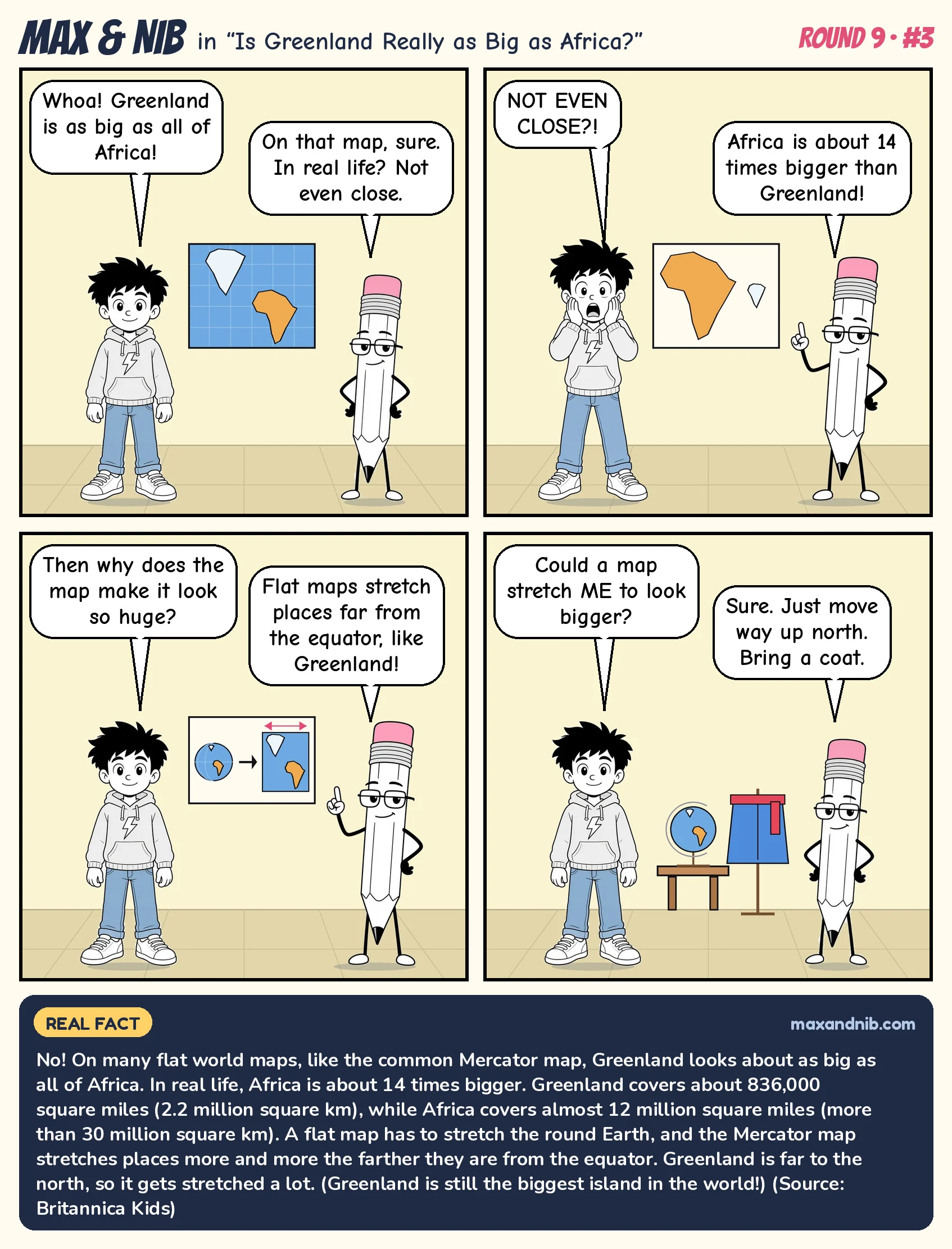
Max looks at a flat world map where Greenland looks as big as Africa and says Greenland is as big as all of Africa; Nib says on that map, sure, but in real life not even close. Max is shocked; Nib points to a chart showing Africa and Greenland at their real sizes and says Africa is about 14 times bigger. Max asks why the map makes Greenland look so huge; Nib points to a chart of a round globe turning into a flat map that gets stretched at the top, and says flat maps stretch places far from the equator, like Greenland. Next to a globe and a winter coat on a coat rack, Max asks if a map could stretch him to look bigger; Nib says sure, just move way up north, and bring a coat.
Comic · Earth & Geography

Is Greenland Really as Big as Africa?

Real fact: No! On many flat world maps, like the common Mercator map, Greenland looks about as big as all of Africa. In real life, Africa is about 14 times bigger. Greenland covers about 836,000 square miles (2.2 million square km), while Africa covers almost 12 million square miles (more than 30 million square km). A flat map has to stretch the round Earth, and the Mercator map stretches places more and more the farther they are from the equator. Greenland is far to the north, so it gets stretched a lot. (Greenland is still the biggest island in the world!)

Where this fact comes from
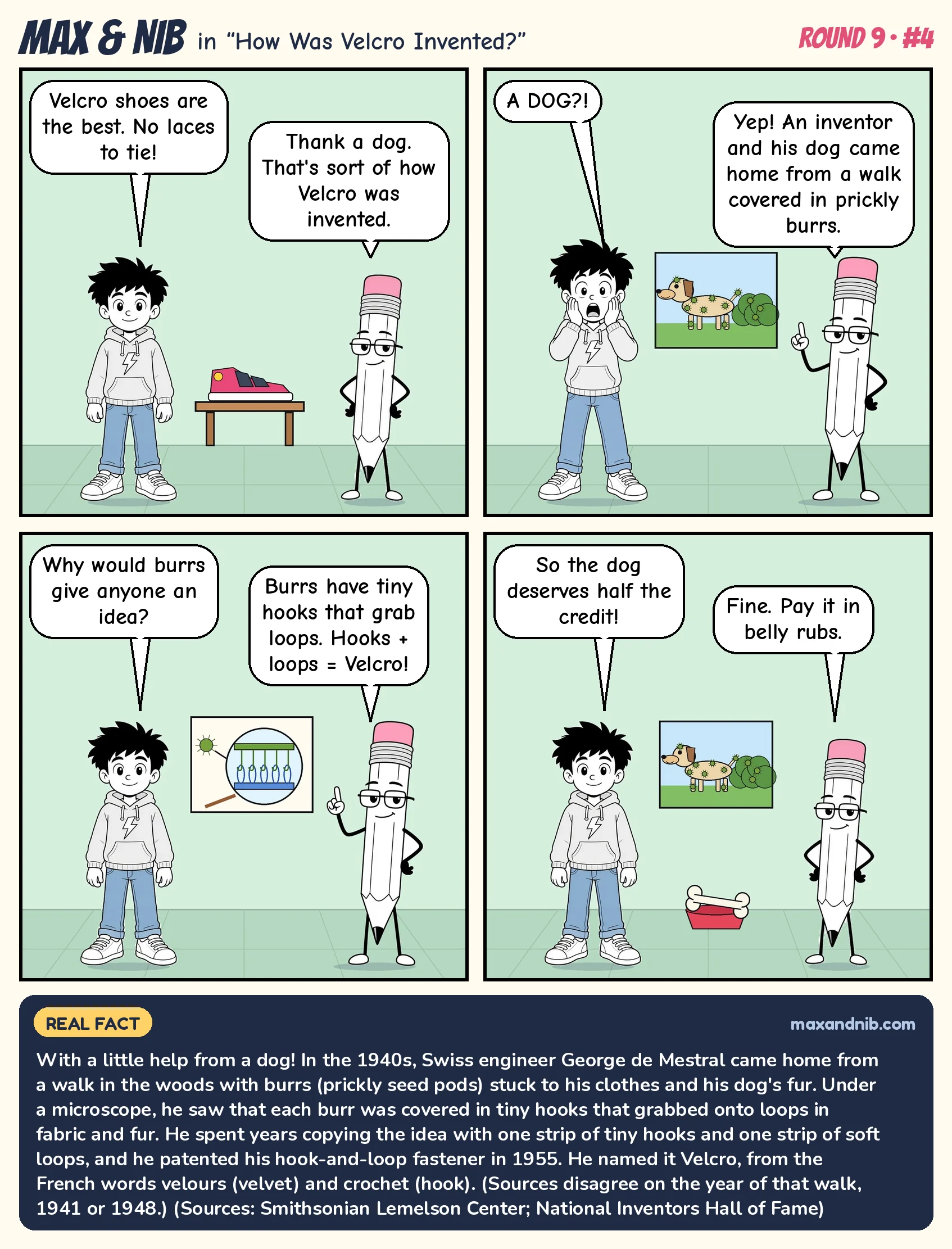
Max, next to a sneaker with hook-and-loop straps, says Velcro shoes are the best because there are no laces to tie; Nib says to thank a dog, because that's sort of how Velcro was invented. Max is shocked; Nib points to a poster of a dog covered in prickly burrs next to a burdock bush and says an inventor and his dog came home from a walk covered in burrs. Max asks why burrs would give anyone an idea; Nib points to a magnified chart of tiny hooks grabbing loops and says burrs have tiny hooks that grab loops, so hooks plus loops equals Velcro. Next to a dog bowl with a bone, Max says the dog deserves half the credit; Nib says fine, pay it in belly rubs.
Comic · Tech & Inventions

How Was Velcro Invented?

Real fact: With a little help from a dog! In the 1940s, Swiss engineer George de Mestral came home from a walk in the woods with burrs (prickly seed pods) stuck to his clothes and his dog's fur. Under a microscope, he saw that each burr was covered in tiny hooks that grabbed onto loops in fabric and fur. He spent years copying the idea with one strip of tiny hooks and one strip of soft loops, and he patented his hook-and-loop fastener in 1955. He named it Velcro, from the French words velours (velvet) and crochet (hook). (Sources disagree on the year of that walk, 1941 or 1948.) (Sources: Smithsonian Lemelson Center; National Inventors Hall of Fame)

Where this fact comes from